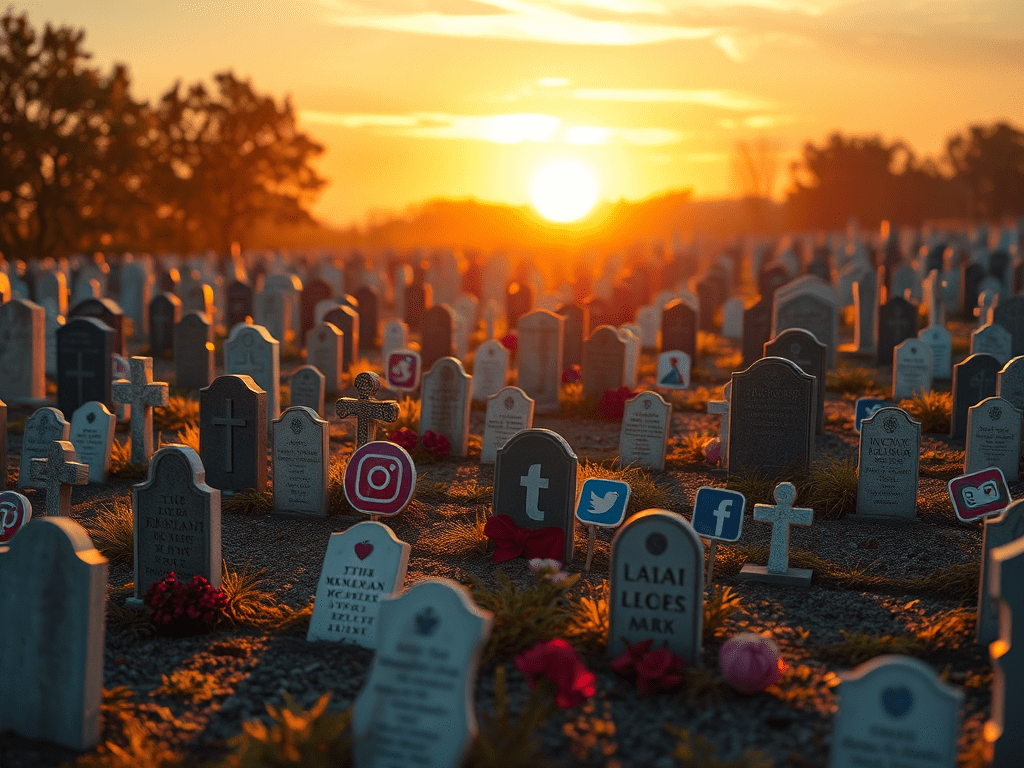
What is Death Now?
What if death no longer means disappearing?
We used to bury the dead. Now we upload them.
We used to grieve in silence. Now we grieve in comments.
Death is no longer a curtain call, it’s a playlist.
In this age of eternal footage, AI griefbots, and ultra-HD memories, death hasn’t stopped happening… it’s just stopped feeling as real. We’ve digitised ghosts but does this linger the healing of our wounds or speed them up.
What happens to mourning when the dead never leave your feed?
Death is simple, being alive is the complicated part. As time and man’s mind weaves technology into an assemblage of something no longer gaudy but on the precipice of our notion of God itself. Emerging from its previous winters, where its potential was covered by avalanches of missing nuance and limitations. Now we are at the point of no return, AI rides a horse, but is it pale white? When someone died, depending on how far back you want to go, their death was the mark of finite biological entropy. They no longer existed but within the memories, or maybe even photographs or a VHS recording. Digital memorialisation has come a long way, Instagram and Facebook pages of deceased become a deathscape to pay respects, or disrespects. Griefbots are created to mimic our loved ones, one can even wear a VR headset and simulate their immaculate revival as much as currently possible. Online videos, be it of public figure or private, in qualities far beyond what previously captured moments in time, serve to freeze their existence. The memory is unreliable, in fact, every time you remember something, you are merely remembering the last time you remembered it. Now, especially with AI upscaling, there is no room for inaccuracy, their moments remain immortal and honest, objective not subjective.
Terror Management & the Illusion of Presence
Terror management, a theory born from Becker’s prize winning ‘The Denial of Death’, essentially posits that humans are in a constant conscious to unconscious state of managing their existential crisis of mortality. Now we exist with the same existential dread of mortality, but we have a fairly convincing and to some, soothing, illusion of presence. Maybe our terror is no longer of death itself, but if we are to merely become content to be scrolled. Our we now a morbid curiosity waiting to happen? A celebrity dies, now their latest photos are descended upon like an orchestra of singing Cherubium, but instead of divine chorus, it is R.I.P, press F for respects, and emojis. You can google a human dying, you can google humans dying in more graphic ways than you thought possible, the quality is good, the picture is clear, the audio is loud and without artifacts. You are now cosplaying as a vicarious ghostly spectator, who has travelled into the past to watch someone die. Men of war used to look into the eyes of the men they killed, now they still do, through a screen as their drone drops a grenade onto the enemy. Alas, war still happens, as Fallout proclaims, it never changes, and all I know of it is my historical interests and online videos.
Grief in the Age of Footage
Death still reaps the soul, but it would seem some form of replica, imprint, tulpa, survives, like a snake that has shed its skin. Is it harder to mourn someone when you have footage of them to relive their moments? Is it comforting? My grandfather died not too long ago, I was and still am devastated. He was a man who encapsulated the word unique, and I am convinced that the world lost essence after his passing. My coping mechanism is that I was lucky to not only know him for as long as I did but have him as my grandad. I have a lot of footage of him, many videos, during my grieving I would add some of it to my montages comprised of footage of my life. I can no longer watch footage of him, it feels taboo, it hurts too much, at most I will play a few seconds to hear his voice. I am the same with my dog Stan, I remind myself on the inflections of his barks, but seldom do I watch him. For others, these existential and emotional dilemmas may be different, there is no right or wrong way of grieving. Barthes said, “A photograph is a certificate of presence… and of absence.”, this encapsulates the bittersweet nectar of existing not only as a finite biology but feeling the sensations of such.
 AMKent books
Leave a comment