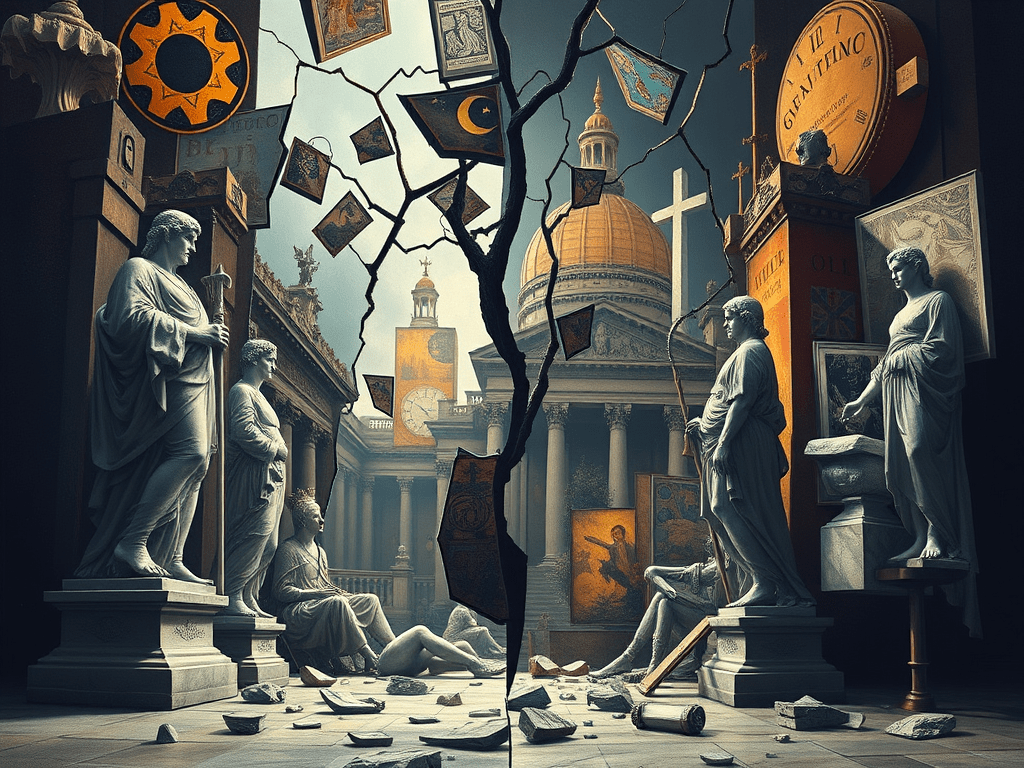
Postmodernity and Progressive Liberalism
Metanarratives
This is the first in an ongoing series of analyses and critiques on societal structures and politics, I thought I would start with the most current, relevant, and ideologically popular first. Jean-François Lyotard famously described postmodernity as an “incredulity toward metanarratives.” This means that postmodernity has scrapped old metanarratives (In social theory and philosophy, a metanarrative is a large, overarching story or narrative that attempts to explain or provide a comprehensive understanding of history, society, or reality) within modernist societies, such as progression, in favour of the dissolution of social constructs and expectations. Immediately, we run into our first issue, the paradox of no metanarratives being a metanarrative. Additionally, the dissolution of societal structures dissolves not only the perceived bad (gender stereotypes, identity, rigid and non-flexible structures in moralism). Additionally, it also dissolves the good, undermining them as outdated or irrelevant (belief systems like Christianity, moral frameworks akin to traditionalism, collective purposes of the metanarrative).
Moral Relativism
This leads to moral relativism and hyper-relativism, something often touted by right-wing thinkers. Everyone now has their subjective view on what the truth is, and all are equally valid in the eyes of a postmodernist society (unless it’s traditionalist). This makes the distinction between what is valid and what is not valid a rather messy and chaotic affair. Take identity for example, sex and gender are an ongoing struggle in the eyes of the law and a polarised issue to many left and right thinkers. I am not here to tell you what to believe, but this is an example of postmodernity muddying the waters of once solidified consensus. It is essentially epistemological chaos; it polarises a society, with the left and postmodernity enjoyers shouting, “Why can’t you respect this new thing!” and the right shouting, “It is new, but that doesn’t make it right!”.
Nihilism
If you are into philosophy, you will see the grooming of nihilism emerging from this hyper-scepticism of everything once grounded in ‘science and traditional thought’. Historical continuity is going out the window to make room for a new era, be it good or bad (subjective); essentially, our entire knowledge base, the foundations of all we know, is now disregarded for a purgatory.
Cultural Abstraction
Cultural decay, or improvement depending on how you see it, is another byproduct of postmodernity and liberalism. Think of the arts, the most obvious example, Picasso’s cubism, modern art in general, compared to neoclassical, academic art. Greek sculptures vs The Messy Bed, or even music, Bach, Mozart, Beethoven, Alkan, Chopin, structurally traditional, and a genius level of musical understanding. While today’s music reaches emotional immediacy and cultural relevance, it often lacks the technical depth of the classical era, a shift reflecting broader societal trends toward accessibility over complexity. The structure has gone from technical to the point only a select few could create or recreate, to minimalist, abstract, repetitive, and less technically competent. Why can’t I enjoy both? Well, you can, I do, but I am merely logging the effects of liberalism and postmodernity. “It is subjective!”, “I enjoy Ariana Grande more than Bach!”. Yes, it is, and you can, but this is the hyper-relativism I spoke of previously, all our truths are equally valid, despite traditionally, Bach and Grande being of zero comparison in musicianship or artistry.
Individualism, Equity, and Inclusion
Now I move onto the touchy area, identity, and the problems with hyper-individualism (ohhh how many times can I add hyper to something?). I’ll make this short and hopefully, fairly sharp. Identity allows people to become a more labelled individual, bringing forth their intersectionality and using linguistic bookmarks to help you understand their key traits. It also creates an oppressed vs oppressor narrative in our society without narratives. This is often referred to as equity, rather than equality, and is something most Western and European societies favour. We’re in a place where identity has become a form of social capital. People get social credit for being part of a marginalised group, and the question arises, how healthy is that for a polarised society? Meritocracy is neutered for equity (think DEI). Equity can fuel a sort of victimhood complex, and it can feel like success is being redefined to mean “representation” rather than achievement. The irony is that the underrepresented have become overrepresented per capita. This pushes serious issues from the ‘oppressors’ to the sidelines in favour of the ‘oppressed’. White male suicide rates (70–90% in the UK) are horrendous and rarely treated as a national crisis, for example. The good from this is that people who are dismissed are now able to get a foot in the door.
Anti-Logic
So, lived experience is now favoured more than traditional logic; we are entering an anti-logic era, and thus we reach the core of postmodernism and liberalism. The dissolution of classical structures means heading towards not just nihilism but a form of anarchy. Race is a social construct, so why can’t a white person say they are black? Gender is a social construct (John Money and Foucault), so it must differ from biological sex. Even age is a social construct, although I hope that one stays intact as a concept, as the dissolution there is grim. Personal autonomy takes the win over traditionalist forms of social cohesion, and ideas of family are transformed.
Community and Crime
Some may argue that liberalism erodes the communal bonds of traditional modernity with its hyper-individual focus, whilst others may argue that it strengthens them with newfound flexibility. National identity is dissolved through open borders and a global society or village. Interconnectedness brings us new culture, new thought, and new chances at intermingling with varied epistemologies. Additionally, crime stats from certain regions are hard to ignore, even globally. While socioeconomic deprivation and systemic disadvantage undoubtedly contribute to criminality, it is also clear that certain patterns persist across European contexts that challenge purely economic explanations. A more honest discourse must address not only these socioeconomic factors but also cultural integration, identity friction, and the long-term effects of parallel societies. To ignore these patterns is to betray the very populations liberal democracies claim to protect.
Studies on Migrant Crime
“58 per cent of those suspect for total crime on reasonable grounds are migrants. Regarding murder, manslaughter and attempted murder, the figures are 73 per cent, while the proportion of robbery is 70 per cent. Non-registered migrants are linked to about 13 per cent of total crime. Given the fact that this group is small, crime propensity among non-registered migrants is significant.” – Migrants and Crime in Sweden in the Twenty-First Century, 2020.
“3 out of 4 cases of murder, manslaughter, and attempted murder in Sweden attributable to migration.”- Ript, 2024.
“Nearly 80% of all charges related to terrorism in the UK since 2001 were connected to a group or ideology based outside of the country, i.e., ‘international terrorism’.” – MigrantwatchUK
Globalism and Polarisation
Postmodern liberalism, with its emphasis on open borders and pluralism, faces a paradox: the more radically inclusive it becomes, the more its foundational values, like tolerance, freedom, and cohesion, are tested. If all cultural values are equally valid, how does a society mediate conflict between those values, especially when they come into direct contradiction? Nowhere is this tension clearer than in discussions around crime and integration. This is not to diminish the cultural, economic, and demographic vitality that migration can bring. But an honest society must be capable of assessing both its successes and its failures, particularly when the latter are disproportionately borne by its most vulnerable. This brings a rise to groups that look to reform society to a more modernist and nationalistic status. Questions arise here: Are all cultures equal? Can they all exist in harmony? I will let the reader figure that one out.
Opposing Studies on Migrant Crime
“The conservative outlet The Spectator takes the opportunity to question the fact that there was a rise in hate crimes after the referendum. Gayle (2017) in The Guardian cites the defence lawyer’s statement on the racist abuse towards some youths in the group but fails to offer any analysis of the fact that the progressive press had gotten it wrong the year before.” -Sage Journals, Ascriptions of migration: Racism, migratism and Brexit
“Data shows that immigrants, often younger, male, and less educated compared to natives, are disproportionately represented among offenders in numerous host countries. However, existing research, inclusive of our analysis of new international data, consistently indicates that immigration does not significantly impact local crime rates in these countries. Furthermore, recent studies underscore that obtaining legal status diminishes immigrants’ involvement in criminal activities.”- Journal of Economic Perspectives, Immigration and Crime; An International Perspective.
“This research explores migrant presentation in newspaper articles containing migrant crime. Thematic content analysis is employed to examine the narratives used in generalized negative discussion of migration in 100 randomly sampled articles from 6 newspapers in Canada, the UK, and the U.S. in 2018. We uncovered 13 themes, such as failure of the state, rapists and criminals, and terrorism. The findings highlight the type and variety of generalized negative narratives found in migrant crime reporting, and suggest the ongoing presentation of these stereotypes. Implications include the influence on public and political attitudes amidst an increasing need for media accountability.”- Broad Strokes for ‘Foreign Folks’: A Thematic Content Analysis of Migration within News Articles Containing Migrant Crime
Anomic Conclusion
Finally, we reach a state of what Durkheim called ‘Anomie’; those who know me know I am a big fan of this concept. It is when the old values of society are rapidly replaced with new ones, and thus, many are left in the limbo of value purgatory. Postmodernity and Liberalism move these values faster than any other societal model, and thus we have a massively polarised population and a whole lot of anomie. Everything is now pastiche, there is no unifying culture. There is a deep suspicion of sincerity, everything is deconstructed. Tolerating everything can lead to tolerating intolerance. Social capital is no longer meritocratic, it is who you are, what struggles you have, and how many niche labels apply to you. Welcome to postmodernity!
Links
https://www.migrationwatchuk.org/briefing-paper/520/is-immigration-a-threat-to-uk-security
https://journals.sagepub.com/doi/full/10.1177/13675494221101642
https://www.aeaweb.org/articles?id=10.1257/jep.38.1.181
https://www.tandfonline.com/doi/abs/10.1080/15562948.2021.1995925


Leave a comment