“For it is the great beast that’s evil is so pure it is love, and love so pure that it is evil, and I am everything in-between.”
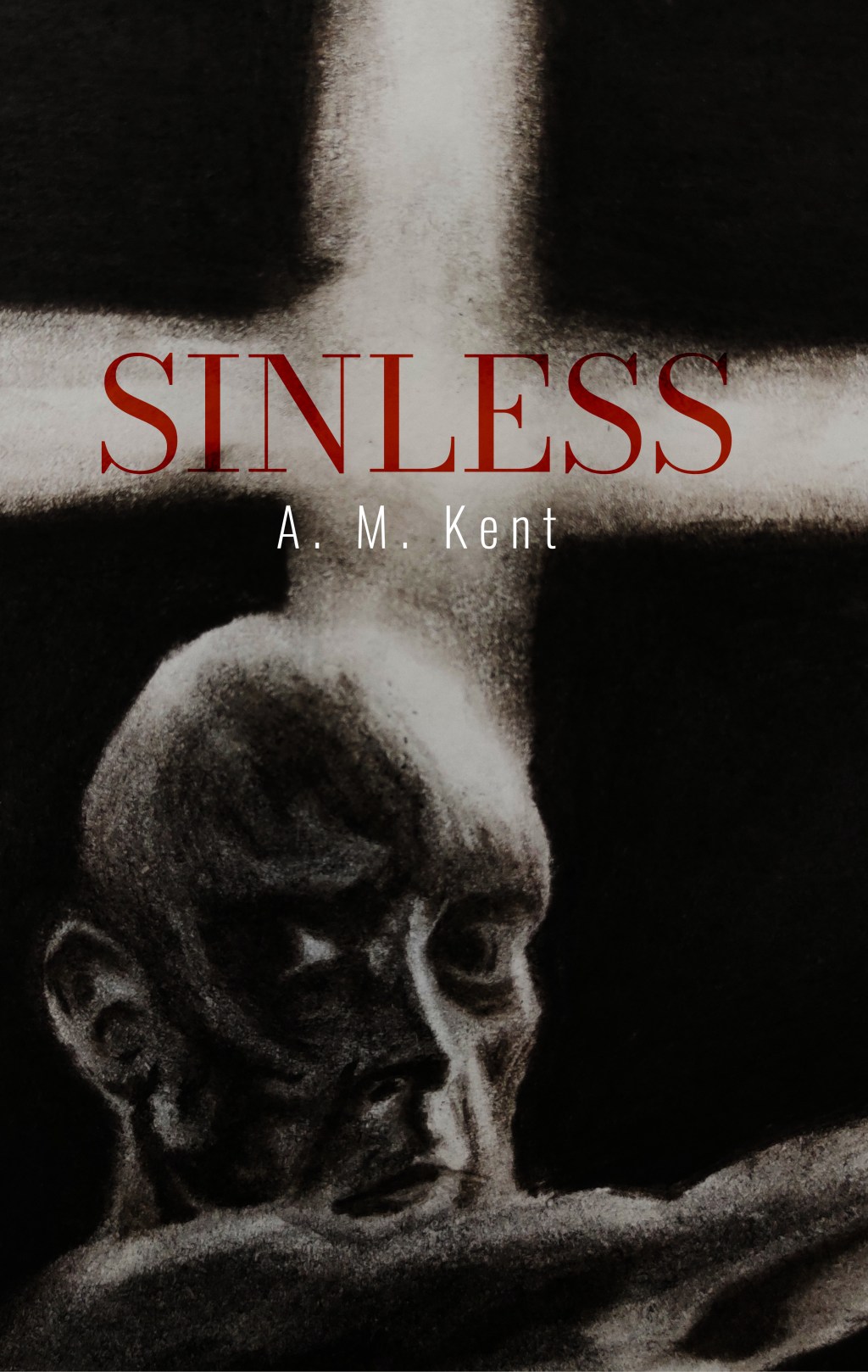
This is the last line written in ‘Sinless’, after Joshua (the protagonist) and Sinless (the antagonist) are crucified facing one another, for all eternity. They both mirror love and evil, sinless and sinful, divinity and mortality, and as long as the mind of man exists, so it shall be. A distinction is made between the need for nails in the hands of Joshua (control to keep humanity in place) opposed to Sinless requiring no such nails (divinity as an abstract idea of superiority, truly free through its own doing). The church burns, meaning the house of philosophy the towns folk had been taught lessons through had dissolved. They had finally revolted against the great beast, chasing it into the house of its ideology. Joshua enters the church before it is burned to the ground to speak to Sinless one final time, he is handed a gun for safety. In the church it is revealed that Sinless really does speak to the creator, but not God as they thought, the creator of the story instead (me and those who read). He demonstrates this by altering the story, making Joshua mutilate and disarm himself before carrying him outside. As long as you read Joshua is unable to stop Sinless and his fate, for love and evil can only exist within the mind.
“It is better to decompose in the belly of that which is divine than to exist in that which is not.”
This line is said by Joshua after he had beat a man to death, he pushes dirt onto the deceased mans face to cover his humanity. Joshua further strangles the body, to which Sinless comments that he cannot strangle the spirit of a dead man with mortal hands. Joshua in this moment allows the pleasure of his violence and anger to reach a climax, to purge itself onto a man who he felt had wronged him even after the finality of mortal death. Sinless tells Joshua that death is a castle of cards, and the soul is an ace perched at the top of this balancing act. Without the foundations, the stack will fall and the soul becomes unreachable, when Joshua queries if the hand could not simply lower itself to collect the ace amongst the rubble. Sinless laughs, claiming that the hand of divinity does not lower itself to collect those who could not sustain themselves high enough to be collected in the first place. The scene ends with Sinless eating the brain of the dead man, and Joshua imitating him (as if he were imitating divinity). This cannibalism, as spoke about in a previous blog, is also a reference to the body of Christ (divinity) that is consumed in religion metaphorically as bread and wine.
“Anguish will ride its stallion of despair through our every breath, then we will cease to be free, and it shall be as if we were tormented birds in a cage of broken glass.”
This is a brief discussion on some of the aspects of the book, including a very short analysis on the meaning of the ending. I had spent many years writing and refining this book, and so there is a lot of meaning jammed into every scene, I would not also want to write a blog exhausting every interpretation as I feel this would spoil the fun for the reader. If you have read the book I hope this has shed some light on some of the more abstract elements of the story, if you have not then I hope this dive into the contents has interested you enough to check it out ! Many thanks for taking any time to read this and below I will provide a link to the book on amazon !
Sinless By A.M. Kent http://getbook.at/SINLESS


Leave a comment