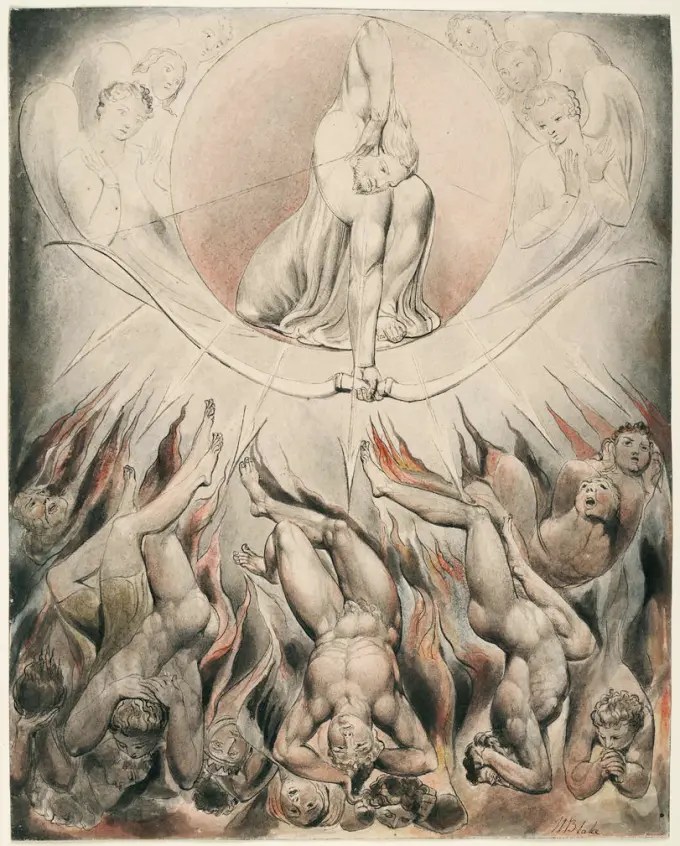
Mary & Christ as The Soul
Whilst I promised myself I would avoid heavy physics in this exploration, I need to delve into some concepts momentarily. The higher the dimensions are, the more abstract our understanding of existence becomes. An example of this would be the 5th dimension, where time is a singular existence, so, death becomes meaningless, it is merely a point on a body metaphorically. My paradigm accounts for this, in-fact, it hinges on it, as the observer effect of the absolute is filtered down through dimensions. A funnelling effect of sorts, but this is not about the idiosyncrasies of the physics surrounding the paradigm. At a certain point, within the higher echelons of dimensionality, contradictions begin to intertwine, paradoxical nature becomes unavoidable. To put it simply, everything exists, all lifetimes, all absences of existence. When applying this to Christ and Mary, they in other realities would be Judas, the Antichrist, the Jewish council, the Roman that pierced the rib of a crucified Christ. The closer to the absolute one gets, the less their existence can harbour meaning, they are abstracted into everything, infinite of infinities, all powerful and no power at all. If anything, their symbolic weight is increased knowing this, they make sense in their divine poignancy for our dimensional understanding, they transcend us but we can still grasp their essence. The soul, the God-head of my paradigm, is locked into an endless cycle of martyrdom by its own nature, it creates, then its creation destroys it, only to recreate it and be destroyed in turn, endlessly. Christ, according to religion doctrine, comes back, but when he does, it is supposedly the end, a final battle between good and evil. If my paradigm applies here, then the battle will end, but its victor will invert into creating its antagonist once again, in a role reversal, good turns to evil, evil turns to good. I wonder, why Mary appears when she does, why she is silent to us all, except those select by her graces. It is inherently human to conclude things, create a comprehensible narrative, paradigms are mostly just that, as Kuhn knew all too well. My paradigm in this case does the opposite, it embraces its lack of sense, the paradoxical nature of chaos, and the martyrdom and rebirth of an infinite cosmic dance where the partners switch positions for all that there is.
Mary and Christ are closer to something than a baseline human is, or they are at the very least, able to understand and manifest their connection to ‘The Soul’, the absolute, God. Mary is a metamorphosis, a transcendental icon of the poignant catalyst and mirror to infinite existences that a single soul can be. A singularity, if Mary is the star, than her collapse is Christ, and when looking at apparitions, he is much more elusive and more reminiscent of what lies past an event horizon. I find good and evil compelling, despite my prevailing belief that it matters not on any grand cosmic sense. Humans ability to do both good and evil transcends social utility, natural evolution, it can be to their conscious detriment, an informed martyrdom of their own. Mary and her silence may speak volumes, to those who truly listen, we all have a mother, how else would we exist. Mary and Christ, if physics and my paradigm are correct, will switch places, over and over, as will all the stars is the cosmos, and all the cosmoses in the chain-mail. For even God switches places with the antagonist, but does this absolute, God, ever switch places with something so inferior, a mortal. According to scripture, Christ is God, they are a trinity, without it, Christ claimed to be the son of God. Could Christ’s final iteration be the collapsed observed, finally becoming the observer, the creation finally gazing back into the eyes of its creator. Could all of an infinite of infinities of the observed culminate into one person, a soul of flesh to the soul of the ultimate top-down ethereal observer. Consciousness is a reaction to the observation of ‘The Soul’, in a more scripture-esque way, Christ is a reaction to the observation of God.
 AMKent books
Leave a comment