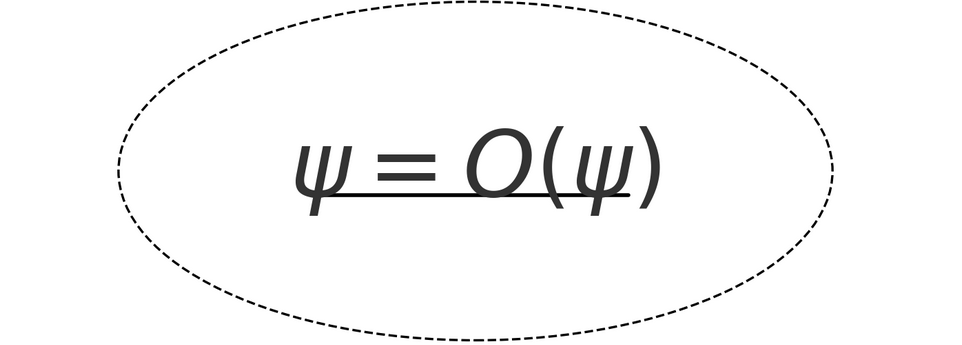
Preface
Within this manifesto I will be presenting a unified ontological paradigm, whilst I will use empirical data and hard science correlations at times, this is primarily a treatise. The paradigm uses physics, theology, mythology, phenomenology, recursion, and metaphor as materials. I am not presenting this as academic hard science, but coherent explanatory architecture for consciousness and existence. The paradigm is a combination of rigorous thought experimentation, research, and poetic exploration through dialogues. It is unconventional, fringe, but provides an interesting alternative structure for not just consciousness, but the entire function of reality. It is meant to challenge, to provoke, and to offer a different way of seeing the universe and the nature of anthropological bias: one in which observation, suffering, meaning, and existence form an inseparable ontological circuit. Our creator is a martyr, and thus so is all of its inadvertent creation, consciousness is a reaction to the observation of the absolute, the Godhead, Monad, or Soul. This form of metaphysics and philosophy is called ‘Martyric Consciousness’ due to the auto-sacographic nature of existence (self-devouring), we are all martyrs to our own creations. This is a philosophy of being in which observation wounds, reaction births awareness, and creation is inseparable from sacrifice. To avoid misinterpretation, it is necessary to outline the methodological principles that guide this work. Again, I will state that this is not strictly academic or without limitations, it serves as a cohesive theory on the existence of an absolute ethereal top-down antagonist.
Methodology
This work is constructed through a hybrid methodology that blends philosophical argumentation, symbolic analysis, and speculative metaphysics. Because the paradigm seeks to describe the underlying architecture of consciousness and existence, it necessarily draws from multiple domains such as physics, theology, mythology, phenomenology, and cognitive science, without restricting itself to the empirical constraints of any single discipline. The aim is coherence, not orthodoxy. This is not an academic paper or contribution to hard science, this is an ontological manifesto and exploration of a fringe paradigm through a multidisciplinary approach.
1. Ontological Prioritisation
The centre of this paradigm is ontological, not epistemological. I begin from the assumption that reality possesses an underlying structural logic, one that precedes human interpretation and remains operative regardless of cultural or scientific framing. The purpose of this manifesto is to articulate that structure, not merely to describe the human experience of it. Essentially, whilst being human, I am trying to shed my anthropomorphic perception, essentially dismantle the sapiens window with the tools that we have built to make it.
Thus, the method prioritises:
- foundational principles,
- structural consistency,
- and categorical clarity
over empirical testability.
2. Use of Science as Conceptual Scaffolding
When I reference quantum mechanics, cosmology, or neurocognitive models, I am not claiming scientific equivalence. Rather, scientific concepts appear here as symbolic scaffolds, metaphors, analogies, and structural mirrors that help illuminate ontological claims. This prevents the common misreading that metaphysical speculation must be judged strictly by empirical standards. Science is ever-evolving, as is its nature, I am not trying to conform this paradigm to current scientific understanding, this would only constrain it and force me to play a role that is not natural to me.
Science supplies the language of structure; metaphysics supplies the logic of being.
3. Thought Experimentation and Internal Coherence
The primary methodological tool in this work is rigorous thought experimentation. Each concept, Soul, observation, martyrdom, reaction, consciousness, is tested against its own internal logic. The aim is to build a system that is:
- self-consistent,
- non-contradictory,
- fractal in structure,
- and capable of explaining multiple phenomena under a unified lens.
Where contradictions arise, they are addressed directly rather than hidden. Where paradox is irreducible, it is acknowledged as part of the nature of being.
4. Phenomenological Grounding
Although the paradigm is metaphysical, it is not detached from lived experience. Phenomenology, the direct examination of subjective consciousness, humanism and objectivism, plays a crucial role in verifying the logic of the system.
I examine:
- the feeling of being observed, what reaction this creates.
- the weight of selfhood, what our design is and how we utilise it.
- the nature of suffering, why do we feel our own entropy?
- the tension between agency and determinism.
- The recursive structure of the human as it correlates to a reactionary existence.
These phenomena serve as experiential evidence for the ontological claims, not the other way around.
5. Theological and Mythological Resonance
Mythic and theological narratives appear throughout this work as archetypal mirrors. They are not sources of dogma, but repositories of metaphysical intuition. When I invoke figures such as Christ, Mary, or the Monad in the hidden gnostic texts, I do so to clarify structural relations within the paradigm, not to assert religious authority.
Myth is treated as symbolic ontology: a way humanity has historically intuited the shape of the real.
6. Dialogues and Poetic Exploration
Some sections employ dialogue, poetic language, or fictional exposition. These are not stylistic indulgences, but methodological tools. The limitations of analytic prose can obscure certain metaphysical relationships; narrative and metaphor often reveal them more sharply.
Dialogues allow competing interpretations to be explored.
Poetry exposes the intuitive dimension of the paradigm.
Fictional constructs (such as artificial entities) test the model’s boundaries and the boundary of anthropomorphism.
I do not believe any meaningful conclusion to the nature of our existence can be made without the inclusion of art, as this is the very thing that defines the void.
7. Scope and Limits
This manifesto does not claim:
- empirical verification,
- divine revelation,
- or absolute finality.
What it does claim is:
- structural coherence,
- explanatory power,
- metaphysical necessity,
- and ontological plausibility.
The framework presented here is designed to be extended, challenged, or revised as new insights emerge. It is not a closed system; it is a foundation.
Chapter 1: Martyric Consciousness
Abstract
This work proposes a metaphysical paradigm in which consciousness is not an emergent property of matter but a reaction to an underlying, top-down observer. The universe and its observer form a single recursive process: each martyrs itself through observation, collapsing into palatable forms of awareness. The observer in this paradigm assumes many names, yet it is essentially the Absolute, a presence existing on a dimension where paradox itself is structural. I theorise this to be the sixth dimension, where observation and existence are indistinguishable states.
When matter is observed, it collapses and transforms itself; this event constitutes both the beginning and end of the universe, though these terms lose their linear distinction. The observed becomes a kind of golem, a reflection of its observer, and inadvertently turns its gaze back upon its creator, martyring itself through its own design. In doing so, an endless loop continues, where observer and observed exchange roles in a perpetual recursion, echoing Nietzsche’s notion of eternal return.
Martyric Consciousness is the microcosmic reflection of this macrocosmic act. The collapse of matter becomes palatable to our bodies and brains, and through interoception this collapse is translated into the experience we call consciousness, electromagnetic synchrony. Drawing from quantum mechanics, cosmology, theology, and phenomenology, this work advances a model of the universe as a recursive martyrdom, a self-sustaining cycle of collapse and reflection, creation and erasure. The universe exists to martyr itself in an endless cycle of design, persisting simultaneously in its beginning and ending, observing and being observed.
Introduction
To introduce the paradigm, I will open this text with the meditations that built its creation, as this progresses, further texts with a more academic tone and refined details will be presented. This treatise is a blend of metaphysical speculation and hard-science grounding, although, as will be discussed further on, hard-science may be a limitation to the answers this paradigm seeks. There is a focus on riding oneself as much as possible from anthropic trappings, the human bias, and an attempt to view reality through a lens that disregards continuity as a Cartesian Demon. The term ‘Martyric Consciounsess’ will become more familiar as the text progresses, however, for a short and simplistic explanation, it works from the idea that the universe perpetually martyrs itself in an endless feedback-loop. Our consciousness, on a much less macro-level, does the same, under the guise of coherency as a design to persistence.
Prologue
Meditations on the Soul presents a radical metaphysical theory that reimagines the soul as a top-down, non-agentive observer, functioning as a catalyst for consciousness and reality itself. Drawing from quantum physics, philosophical paradoxes, theological archetypes, and high-dimensional cosmology, A personal paradigm on the nature of all existence where consciousness is not an emergent property of biology but a reactive collapse under the gaze of the soul.
Rather than viewing the soul as a divine, anthropomorphic entity, it is framed as a sixth- or seventh-dimensional function, one that eventually succumbs to the entropy it sets in motion, a martyr of its own infinite recursion. Through essays, dialogues, and poetic reasoning, the work explores themes of paradox, reincarnation, sensation, observation, cosmic data archives, and the transmutation of matter into memory.
Key terms
- The Soul — Not a spirit or self, but a top-down function that observes and thus instantiates the observer-effect; a martyr to its own recursive witnessing.
- Consciousness — A collapse in reaction to the soul’s observation, manifesting experience within entropy, and tethered to time as a form of consequence.
- Entropy — A sacrament of unfolding; the soul’s digestion, creating order only to dismantle it for informational refinement.
A.M. Kent, Meditations on the Soul
Consciousness Is a Reaction to The Observation of The Soul: Meditations on The Soul, Part 1
I will be using Von Nuemann-Wigners ‘Friend’ thought experiment (put simply, consciousness is responsible for quantum matter change under observation, not just devices). The premise of this first contribution to an on-going series will use heavily the quantum mechanical phenomena of matter change under observation. The initial assertation from experiments such as ‘The Double-Slit Experiment’, ‘Quantum Zeno Effect’, ‘Schrodinger’s cat’ and ‘Stress-Induced Phase Transition in Crystals’ is that observation changes matter (be it quantum or classical as is the case with these). Now, on a macro-level observation does not change matter, this is usually a quantum occurrence known as the ‘Observer Effect’. The interaction of observation and measurement collapses wavelengths when tested using either electrons or photons, from waves to particles the matter passes through the slits.
With that loose groundwork set, the soul as an ‘ultimate observer’ can be introduced along with the purpose of this discussion. If the wavelength of consciousness (using Descartes Duality) collapses, then its transformation could transform it into something palatable for our brains to transmit. The Observer in this case would have to be ‘The Soul’, essentially interacting as a non-physical entity with the physical world. Additionally, this would mean that the soul would act as a deeper interactive catalyst than the energy the consciousness is comprised of (current consensus is electromagnetic energy). A popular paradigm is that consciousness evolved through biological matter such as neurotransmitters and dopamine, we are the product of interoception, an internal longitudinal process that led us to awareness. My main problem with this is that in the midst of an infinite universe, an individual biology, or entire tribe (currently nearing 10 billion), creating consciousness from only its own internal mutation seems anthropomorphic. Consciousness, as I shall discuss further along these entries, does not stop at what we perceive as consciousness (to be aware and interact with the external). Nature is hierarchal, and without getting into linguistic problems (see Wittgenstein for that), operates vastly above our encompassment and command of it.
We are three-dimensional, with the arguable ‘illusion’ of cognitive independence to interact with our external surroundings. When I speak of the soul, I do not mean a white blob that drifts in and out of every human, I see it more as a top-down ethereal antagonist. It acts as an ultimate observer for all mater in its primal form, but what we perceive of it in our dimensional limitations is unseen (Think the book ‘Flatland’ by Abbott, how the 2D could not comprehend the 3D cube, or the cube to the 4D tesseract). Essentially, this cyclical reaction from observational interaction could be what self-propagates an eternal flame so to speak, or an ever-expanding universe. I understand these implications are severe, grandiose, and some may feel the soul could be some kind of place holder for a ‘God’. Additionally, the irony of my dismissal of the internal evolution of consciousness in the human brain vs the internal evolution of all-matter to a soul is not lost on me. The nuances here is what shall make the difference, there may be something beyond this ultimate observer, but for now the focus is on the soul.
Individuality, Collectivism, Transmigration or Situated?: Meditations on The Soul Part 2
Plato argued that the soul was immortal, that it outlived its fleshy shell after death and that it existed before birth and after birth. This made a difference from Pythagoreans who believed in the transmigration of souls, the soul, in an attempt to purify itself, continues to adopt living bodies until it has done so. The came Aristotle who believed that the soul was a kind of essence that died with the body, comprising of a vegetative soul (inherent in even plants, it is the reason for our primality) and the rational soul (logic, reasoning, only belonging to humans). My interest here is an amalgamation of these three Greek philosophers for this article entry. Let us begin with Plato, who believed that the evidence of universal truths was a form of evidence for the mind recalling the knowledge of an eternal soul. The easiest example of this is mathematical truths, as two objects that look the same under a microscope may differ wildly. Whilst, mathematics and geometrics maintained perfect logical principles, for example the perfect circle!
To a degree, I feel Plato has found the crumbs to a potential journey on the nature of the soul. As my last article posited, the soul is an infinite, top-down, ultimate observer, therefore, it would have existed before the physical form of a human. This idea of recollection in matters of ‘truths’ is something that may have some merit also. I think the instinctual primal truths, such as breathing, thinking, motion if capable, and utilisation of the senses which fundamentally contradict. Is to a degree the recollection of a more ordered and sustainable reaction under the observation of the soul. Consciousness as a reaction, like wavelengths that collapse into ordered matter, orders itself to ‘play ball’ with the biological ‘slits’ of a human brain. With the soul as a sort of ‘Godhead’, is transmigration possible? Well, as consciousness is merely the collapse of a form into another, then transmigration would require a reversal of the matter and the process, only to repeat itself again. Reminiscent of the paradigm of nothingness reversing itself into everything (a horribly simplified version of the theory of everything).
There are some truly unfathomable stories surrounding cases of reincarnation, with seemingly impossible coincidences. Whilst this is pure conjecture (as are all these meditations), I imagine the likelihood of conscious matter undergoing this cycle and transmigrating to another human is extremely rare. If we take these anomalous reincarnation stories seriously though, it would seem that when it does happen, this ability to ‘recall’ is present, as they remember stunning details surrounding their past lives. Finally, to end this short entry, I shall bring in Aristotle. The impact Aristotle had on western society, potentially Alexander The Great, metaphysics and intellectualism is both long-reaching and grandiose. For this reason, this is in no way the end of our time with the great philosophical mind. The vegetative soul is something that, according to Aristotle’s metaphysics, can be applied to even plants. I believe that consciousness exists in all forms, and whilst a human may not recognise it due to anthropomorphism, it exists, nonetheless. What is to say light is not conscious, its reaction to devices and the observer effect displays a change in nature, it must funnel out of the maze of a star’s womb as a photon particle. Consciousness is something that is not exclusive to humans, because it is a mass reaction to an ultimate observer, not a human developed internal phenomenon.
The faults of consciousness overwhelming our biology also reaffirms this in my opinion. If our brain realises it has eyes, it shall destroy them and we will be blind, without light entering the prism, we would not see colour, in fact, some of us see different colours, hear external voices, see hallucinations (see Charles Bonnet Syndrome for an interesting rabbit hole). These are topics for another entry, but a reaction is a reaction, and if it enters a blind spot, where the observation is no longer sustained, it shall change its form again. Maybe this is in part responsible for such things, or maybe as they say “We are either curing Schizophrenia or killing fairies “.
Sensations as the Ephemeral By-product of Observed Consciousness: Meditations on the Soul, Part 3
Continuing from the paradigm of the soul as an ultimate observer and consciousness being a matter reaction, I now come to the discussion of what our sensations during finite existence may be. As the title suggests, I posit the idea that they may be the by-product of the observer effect, like light through a prism. Matter is not static, so, as it funnels through our brain like photons did through the slits under device observation, a flux rooted in movement is inevitable. This migration of reactive matter transforming through different spatiality of the top-down holistic observation of the soul manifests what we know as sensations. It would be unlikely and against the natural laws of an expanding infinity that a consistent neutral baseline would be established. Even Blackholes eventually suffocate themselves, when they are not cooling down gas to make a feast! These dimensional outlooks may differ greatly depending on the dimension, but, for our three-dimensional form, this topography of funnelled conscious matter is anything but smooth and unchanging. As this matter reacts and interplays with the human brain as its new receiver, these fluctuations cause what we define as sensations.
An interesting question from this is if sensations are from the soul itself, in an instrumental way, the answer is yes. However, they are more akin to the acoustic vibration of a plucked guitar string, or a fading echo from the mouth of the source (Jean Baudrillard Simulacra-esque). Additionally, this would render the content of our reality illusionary, something, unfortunately, that is fairly supported by modern science. We define our perceptions of existence on our sensations, without it, as Descartes proclaimed, we can only doubt that we are. Sensations are the reactions of our mobility through time and gravity, to a degree they may even encompass physical space despite our minute stature within it. To end this on a grander note, I think that this may lead to an idea surrounding an information network, reactions linking a flow of data through an infinite memory. This will be deeper explored later on, however, for now, I end this part here as it is dense in content for its word count!
The Soul’s Temperament: Meditations on the Soul, Part 4.
By A.M. Kent
“The soul becomes dyed with the colour of its thoughts.” Marcus Aurelius, Meditations.
With the causation of consciousness briefly laid as a foundation, along with a flourishing of sensations as by-products. I now would like to move onto the temperament, or nature, of the soul. If it is to act as an ultimate observer, then, without adding a humanistic bias or perception as much as possible, what is the soul’s nature other than an infinite catalyst? I shall discuss a few possibilities, and throughout this evaluation a temporary, yet more plausible conclusion shall hopefully arrive.
The Soul posits consciousness through its reactions, and our sensations of existence are the moving, as we perceive it linearly, through the gaze of the soul as an ultimate observer. It is clear already that for this to be the case, the soul must be many dimensions above what we perceive. Time is often thought of as fifth dimensional, where it would be akin to a physical object more so than a passing hand that ages us. I believe the soul transcends even time, due to the fact that it is the catalyst for an infinitely expanding reaction of all matters. So, with this logic, the soul is at the very least sixth dimensional.
My first hypothesis is that the soul does not have a nature or temperament that we would define in terms of the human spirit, instead, it could be neutral as if it were a mirror reflecting back whatever we throw at it. If this was the case it could account for the infinite nature of the cosmos, and it would also imply that the soul itself was conscious, as it would observe itself, thus creating its own reaction. This is a hypothesis that I favour, as it plays to not only the self-refectory nature of the human condition but also matter in general. Take quantum entanglement, where matter is inexorably linked with utter disregard to the potential vast expanse of distance that separates them, in a seemingly infinite cosmic soup. Such a thing reminds me of Jung’s theory on the collective unconsciousness, and my own in Void Around Sunlight (although I am no Carl Jung!).
Can the soul’s temperament evolve? I believe it must; in order to maintain its top-down structure, it must be the singularity that nature evolves towards. Seen as what exists is infinite, so much so that even energy cannot escape, hence the law of conservation. The soul must outpace infinity. Is it possible that the infinite expansionary reaction of the cosmos itself is some kind of information transference so that the soul can evolve its form? If this were the case, then it would act much more like a hive mind or Boltzmann Brain than this notion of an ethereal antagonist that observes matter. Additionally, if the soul is like a mirror, causing its own metamorphosis, then that would mean that it is comprised of something, be it matter, energy, or otherwise. It seems the theory of a self-reflecting soul brings many questions up; however, this does not necessarily make it a bad thing.
The soul as a catalyst for an ever-growing infinite must exist in a hierarchal structure that is akin to absolutism. It must be a sovereignty to the nature of all, it is a creator but its intentions, if it has any at all, are unclear. The intentions may be what separates it from traditional notions of deities and Godheads. Is there a purpose to this mass creation, or is it simply the by-product of its own existence? When thinking about the span of a humans life, if one is to consider something beyond, then all we can do is attribute it the virtue of patience. If so, and if this is in any way relevant, then whatever the soul is, it has the virtue of patience. This is anthropomorphic in nature, and an argument for anthropomorphism merely being a point on a spectrum of reactionary matter, thus validating and dismissing itself at the same time, could be made. However, this falls back on the idea of the soul being above time, and if so then patience is not something needed as the past, present and future exist all at once from its perception.
It seems at the very least, that the soul is complying with this internal combustion of all that is. It is neither resisting nor advocating. Ideas around the death of the universe additionally need to be investigated, such as heat death or time merely deteriorating, or maybe an eternal return? If this is the case, then it could be said that the soul will inevitably make a martyr out of itself. If the soul causes its own suicide, then it’s being is finite, even if it is vastly beyond our comprehensions of what finite is. This also implies that there is another form of ‘time’ that lingers even over the absolutism’s head. Perhaps a can of worms has truly been opened!
Meditations on the Soul: Dialogues, Part 1
There are several paradoxes that I wish to address within my meditations on the soul, for which I shall do in my next entry. For this however, I am taking a different approach and using an internal stream of conscious dialogue between two hypothetical minds in order to dissect the soul further.
A: I wonder if creating a species as a self-aware finite, bestowed with the sensations of inevitable deterioration indicates intent. If it does, anthropomorphically, one could assume that it is malicious predilection rather than chaotic neutrality.
B: A cruel design indeed, to decay is one thing but to become over encumbered with the sensations of entropy is a rather grim prospect. An impermanent biology cursed with the knowledge of its own decay, wired to fear it—if this were by design, it would be malevolence on an infinite scale.
A: I suppose it may be the only convincing evidence surrounding a teleological argument of sorts, a paradigm of intention.
B: Then we move onto an idea surrounding meaning.
A: Anthropomorphic again, but the passive flow of an unravelling predetermined sequence seems rather uninspired for so much magnificence.
B: An architect creates a building for two primary reasons, a statement of artistic prowess and the utility of shelter. Applying this to an architect of the cosmos then we are both a display of an infinity structure of art. Its meaning would exist within its presentation and the preservation of our and all conditions until the integrity fails. So, with that in mind, does our creator care in a way we could understand about its creation? Is the failure as intentional as the creation? Is there a value in the recognition of it all, much like an artist hopes one recognises their idiosyncrasies?
A: Following the logic of our art, value exists within the finite, its temporality is defined by its transience, fragility, preservation. Self-destruction would be intentional, and fits the idea of natures inevitable suicide, the soul inevitably martyring itself. So, a finite antagonist must linger over even our creator’s head! I think our appetite for philosophical satiation is the intention of this artistic endeavour, we are compelled to recognise the nuance of what we exist within.
B: Would our artist fear its own end then? Or is this all part of the project?
A: If it fears death, then it has a denial of it, and it is no different from its creation.
B: The other option?
A: It would have what we humans call ‘dignity’.
B: We all collapse into the reaction of observation once again, like waves of light to matter.
A: I imagine ‘that’ which is not observed cannot exist.
B: Existence is contingent on its observation, from our ultimate observer ‘The Soul’. However, explain this martyr business, nature’s suicide?
A: Nature is a pyramid, it is top down for us, we all aim towards the point at the summit. The next step of evolution, and the soul, would be to self-cannibalize. Time has all already happened, there is nothing linear left, unless there is something beyond time that emits a linearity on nature. I think that it is the soul that does this, and nature’s final act is its own deconstruction. The soul martyrs itself once the self-reflected observation of nature returns to the void.
B: Entropy strikes again, are we not worshiping a totem pole again? Albeit in a more sophisticated manner, are we not just submitting to our primal tribe mentality?
A: It is hard not to, a nebula’s womb houses stars, such a thing the stoics thought divine. How are we, as hairless apes, supposed to not look at such a complex display of cosmic anatomy and not fall to either admiration or worship?
B: If its all neutral, then we are either a mistake or an abomination.
A: If it is not, then our fingertips are stretching closer to Gods.
B: Does God want our contact though?
A: If so, it has been made a challenge, and our suns inevitable explosion has set a timer upon it.
B: Maybe technology and biology are not the right tools for the job?
A: Something more spiritual? A transcendence of flesh?
B: Maybe, seems too simple for so much complexity. The ultimate observer creates with its observation, and through an infinite chainmail is observed back by an amalgamation of sprawling matter both micro and macro. The finite Frankenstein succumbs to its master’s inevitable blindness, and without the self-reflection our soul returns to its original form.
A: Original? Or something different. I have not worked that part out yet, that is what you are for.
B: How does this fall into reaching the top of our pyramid. We are playing catch-up with someone who has an infinite head start.
A: It seems are best bet is through a form of this observation; we are looked upon and so we shall look back. Now we just need to figure out where to look!
Meditations on the Soul: Dialogues, part 2
This entry will concern itself over the spectrum of sensations, and how such sensations have defined themselves within the experience of the human condition.
A: I find myself wondering how not only these sensations are consistent, yet we define them linguistically, such as love, hate, happiness, and so on.
B: Perhaps there is an underlying answer within the matter of consciousness collapsing and reforming itself through observation?
A: Interesting, such as love acting as a form of cohesion with another’s conscious matter, an alignment, or resonance that connects and creates not only the sensation but the attachment to the consciousness it matched with.
B: Poetic indeed! It fits our paradigm, but then what could hate be?
A: I imagine it would be a disrupter, unmatched, no resonance, a state that is at odds with the constants and variables of its opposed matter. Whatever it is, it would have to be temporary, fleetingly so, but then we find ourselves defining micro causalities of linear time.
B: We as humans have developed and evolved with the ability of pattern recognition, I think there is a pattern to be recognized within this paradigm.
A: Could our pattern be within the internally changing formations of consciousness, it would explain recurring emotions. Unification seems to be sensed in a positive way to our biology, and anti-cohesion negatively. Take for example happiness, perhaps some kind of neutrality that creates a peace within sentience!
B: Then what about nostalgia? It is both a positive and negative, it can be very bittersweet!
A: It can, I think that there could be several answers. Take my first hypothesis, maybe it is the remembrance of a previous formation, a collapsed state that pattern recognition identifies similarities within once again. My second, is that everything within matter is stored, imprinted, and even through these fluctuations under the observation of the soul what truly defines the depth of sentience is our ability to recall.
B: They sound somewhat similar, one relying on pattern recognition on a quantum scale, the other as some kind of internal stored signature. How long would these imprints last?
A: I would say until it leaves the biology of its host, but transmutation of stored information is something I believe in with this paradigm. So, maybe the data is recycled? Perhaps that is why some feel deeper than others, they are working with matter that harbours more contents.
B: It is fundamental to our nature to draw from the recycled impregnations of matter, I suppose its internal mutations are too the product of our ultimate observer.
A: I think that this is the most likely answer, nothing can leave the universe, because the universe is infinite. So, if energy has nowhere to go, it must transmute, reform, expand, but never dissipate.
B: So, our depth and corresponding sensations is a luck of the draw?
A: That I am not entirely sure of, for intention is clear by-products of our ultimate observer. The question becomes, how organised is the soul, has it merely cast a stone to see the ripples, or are we something meticulously planned out.
B: Nature has a direction, and it is the infinite that reaches endlessly towards the soul, so it seems that no matter what level of detail does what. It is bound by the eternal expression of reaching towards its master, so to speak.
A: An intrinsic momentum, it fits the notion of the observer reflecting its observation back upon itself.
The Soul is a Martyr: Meditations on The Soul, Part 5
The Akashic records posit that there is a cosmic library of sorts that contains all thoughts, emotions, desires, and everything else in existence. Certain individuals claim to be able to access this divine archive through meditative practices. Whilst I am not convinced of this, I believe this infinite feedback loop of observation could technically hold something akin to an ethereal cosmic library of collapsed wavelengths of interchanging matter and energy. As the previous entry implied, sensations are not just reactions to the observation of an ultimate observer; they are also essentially data points in a divine spreadsheet of sorts. This implies that maybe schizophrenia is a misfire of sorts? A corrupted data point where observation was temporarily lost? What is temporary for a top-down ultimate antagonist may be a lifetime for us. However, this is merely artistry taking over metaphysics, I shall resume catering to my paradigm more structurally. If the observed eventually frankensteins into something that can observe back, then the martyr of the soul, or God, is tragic and beautiful, fitting with human constructs of aesthetics. It essentially succumbs to an entropy that exceeds absolutism, it would be a divine existentialism. An entropy closing loop where the agent of God, the souls, own demise was what it had created (be it intentionally or not).
So, the golem attacks the master in a sense! This then leads us to another point of contention, a meta-chronology, a reality where entropy exceeds what we would consider infinite. If the absolute can be transgressed, then what lies above it? A cosmic recursion? Seems most likely that this finality that lingers over our ultimate observer’s head would fit into the idea of a recursion. So, what would this recursion be? An eternally begetting entity that creates universes cursed with autosarcography? I find that a chain of command becomes relevant again, hierarchies plague philosophy, and scientific thought. I do not think there is a hierarchy here, I think that if our ultimate observer is the soul, and its creation causes it to transcend, then it must go back to the being it came from. If this is so, then our Akashic records are added to an archive that would make the Library of Alexandria blush. As previously mentioned, again we find Baudrillard becoming useful, a simulacra to end all simulacras! Are we just a hologram? Maybe the interoception of a being so rife with information that we should stay as hairless apes endowed with a morsel of reacted consciousness. That is defeatist in my opinion! I find myself bringing up Christian theology briefly, the emptying of Yaweh to create a human, the martyrdom of Christ, the trinity, all essentially being the same absolute. As a human with pattern recognition, it is hard not to notice my dipping of the toes in Christianity, Gnosticism, and Panpsychism. It is up to the reader to take this as proof of a religion, a merely interesting thought, something original entirely, or utter nonsense. In either case, I find the martyrdom of the soul necessary, maybe not for our sins, or the sins of a cosmos, but for its recognition of the reflection that gazes back at it. What happens next, perhaps that is all there is, or perhaps it feeds into the body of something endlessly experimenting and building an infinite archive of all existence is and could be.
The Functional Absolute, Syntax and Semantics: Meditations on The Soul, Part 6
“I am the spirit that always denies! / And rightly so; for all that comes to be / Deserves to perish wretchedly.”
—Mephistopheles, Goethe’s Faust
The Soul is neither divine nor anthropomorphic, it is a functional absolute, it works as a top-down ethereal antagonist. I will now try and resolve the muddied clarity on if the soul is reaction or a data point. To put it bluntly, the soul as it has been discussed in this paradigm so far, is a data point that eventually becomes a reaction, transforming the kind of data it is. Whilst I have not entirely figured out something I am sold on in terms of origin or what could potentially be above it. I am certain that this absolute initially begins as self-reproducing data, like an echoed voice that slowly becomes distorted from the original source. To clarify this distortion further, the soul begins as a singular informational invariant (like a quantum bit’s base state), but through recursive observation, it bifurcates into dynamic feedback. A reaction that transforms its own initial data into the chainmail of reality. Once the data point has made itself a plurality, the reaction of the observer effect begins, slowly creating an infinite chainmail of reactions until the soul is martyred by its own creation. The Soul, as I have previously stated, must at least be sixth dimensional. The reason I said this which I failed to explain at the time, is that time exists within the fourth dimension, and the soul must exist above that. The fifth dimension is where all realties are said to possibly exist, and again, the soul as an ultimate observer must exist above that, placing it at the very least into the sixth dimension.
The homunculus problem, counterargues something similar to my paradigm in the philosophy of the mind. This problem works on infinite regression, an endless chain of internal observers must be accounted for to explain the homunculus itself. The counterargument in terms of this paradigm is that the soul and consciousness co-arise through reciprocal observation, it essentially becomes a dialectic without hierarchy. However, to play devils advocate, an infinite regression may not be wrong, although it goes against our logic, the infinite cosmos is set to infinitely regress once it has done infinitely expanding. My solution to this issue right now is that the observation that the soul emits, is a property of the system itself, not an actor within it. This falls into a broader argument of purpose and brings me back to the previous entry regarding a cosmic archive collecting data, however, this time a revision would make it self-reading. There’s no “first observer” because observation is a relational property of the system. Additionally, regarding infinite regression, Cantor’s infinities states that an endless hierarchy of infinities is mathematically coherent. The soul’s observation isn’t an act but a constraint, like the laws of physics, it shapes reality by being intrinsic to the system’s logic, not an agent within it. The soul and consciousness are intrinsically different, like water and fire, there is no prime mover, it is a part of the system not its primal actor.
I find Hegel’s Lordship and Bondage being a philosophical back-up to this paradigm (I never thought I would find myself relying on Hegel!). Consciousness is developed through interaction, like the matter that is developed through its initial observation and the movement of its container (Humans, animals, etc) through lineal time. Essentially, our identity is formed through the negotiation of this reaction throughout our existence. Much like Hegel’s master and slave theory, each seeks the others validation, but they are both by-products of the same system. This inherently leads to the martyrdom of the soul because it cannot dominate its own creations. The Soul is unable to govern its own chainmail, its own cascade of reactions, and thus succumbs to its own inception. Finally, the idea of God is not being killed within this paradigm, but God is becoming syntax rather than semantics. Tegmark’s Mathematical Universe Hypothesis posits that reality is not just explained using maths, but it is maths. This is not great news for me, as I am terrible at maths, alas, this creates an interesting notion. The soul is not a sentient being in its own right, it is a mathematical boundary condition.
The Entropic Soul: Meditations on the Soul, Part 6
The soul as a functional top-down ethereal antagonist is not a prime mover, much like notions of gravity; that which moves within it is not from the agency of an individual actor but a by-product of its existence. The Soul itself is not static; although it is the catalyst for all data within the universe, it also evolves through an interaction of experience. This internal interaction under the ultimate observation of the soul-head is much like the internal play of virtues to action in the life of humans. This also displays the endless recursion, a dual mirror effect of martyrdom that our collective, instrumentalised soul goes through. The soul began as data, much like the cell that multiplied in the primordial soup; it transforms from potential data to reaction, solidified information. The soul’s ‘data’ is a quantum possibility space; ‘reaction’ is decoherence, collapsing potential into the ‘solidity’ of observed reality. Like a cosmic natural selection, only stable patterns survive entropy’s sieve, akin to ‘Quantum Darwinism’. As the previous section within dialogues implied, there almost seems to be an anthropomorphic nature to endowing conscious beings with the sensations of their own entropy, malevolent. Our three-dimensional limitations have to be addressed here, what we perceive through our interoception as pain, intent, suffering, joy, etc. This is merely the consequences of existing, there is no spite, we feel the sensations of an unfurling reaction that eventually martyrs itself.
We are data for a cosmic archive, the harvesting may cause suffering on our level, but above us on higher dimensional plains, this experience transforms into the unrecognisable. We run into a persistent and unavoidable problem when delving this deep, there are paradoxes to the soul, but paradoxes are meant to exist. In the 7th dimension, it is hypothesized that what can and what cannot exist together, the antagonist and anti-antagonist in a strange paradoxical unison. This is where we take our next step in the exploration of the entropic soul, what happens once it reaches its possible heat death? The possible answers come in a couple, either it is cyclical, an eternal return of quantifying data through qualitative experience. Or the soul-head is itself harvested as data, its death, like ours, is extrapolated as a part of something that exists above the absolute. I prefer the second option, but I fear the first is the most likely. There is an undeniable cyclical nature to existence, as a low-level species, this is something that we have been able to recognise; in fact, it is one of our greatest achievements. Its cyclical properties encourage our maths and geometry, our metaphysics and philosophy, it is the very tools of our master. The paradox of our soul-head is that it is aSchrödinger’s Godat the seventh dimension; it is both alive and dead, harvesting and retired.
Jung’s coincidentia oppositorum posits that the self is similarly comprised, opposites and the conflict of their paradoxical nature internally battling into the manifestation of the self. There is nothing but a paradox, and the greatest paradox of them all is a corrupt circle, a cycle of all; this is our ethereal antagonist, our top-down observer, this is our soul. It is a higher-dimensional observer, its most plausible existence is 6th-dimensional, where it is paradox-free; however, the more I interrogate this paradigm, the more it would appear its final form is a paradox, be it 7th-dimensional or possibly even higher. Additionally, the way the by-products of the soul-head move suggests something frictionless, akin to superfluid gravity. I shall delve deep into research and address this in a later entry. Superfluid gravity is a fringe yet poignant theory that may help explain dark matter without the need for extracurricular particles like neutrinos. I have a hunch that dark matter may be some kind of residue from the paradoxical nature of a 7th-dimensional soul-head, but right now, this is unfalsifiable metaphysics in a paradigm that represents the metaphysical equivalent of the mad hatter’s tea party!
The Ouroboric Observer: On the Munchausen Soul
“Whoever fights with monsters should see to it that in the process he does not become a monster. And if you gaze long into an abyss, the abyss gazes also into you.” – Friedrich Nietzsche
I have thought about how to resolve the paradoxes that higher dimensionality brings; symmetry is essential as matter and anti-matter intertwine. The soul observes its own sacrifice, and in doing so, the paradox of its existence is that it both creates death and life in an endless cycle. The resolution is that there is no fatigue in the universe; anything akin to an end is short-lived, as the symmetry of an end only brings life once again, akin to Socratic notions of binaries. The soul will collapse into the very entropy it creates; its death will echo through the hierarchy of dimensions until death no longer means anything. In observing its own death, it shall observe the very matter that gave it life, sparking that very life once again. The ouroboros is more than a poetic notion within this paradigm; it is the structure and law of nature, and nature is all, an infinite appetite with an infinite amount of sustenance. Nietszche’s statement on the danger of gazing into the abyss now becomes prophetic, but it is the soul that gazes at us, and we are the void waiting for its line of sight so we may watch it back. A visual signature signed on the very death warrant that only the recurrence of the soul as an ultimate top-down ethereal antagonist could posit.
Cognitive Decoherence
Quantum cognition looks into the paradoxical nature of human logic and memory through mathematics, using concepts such as quantum entanglement. All routes of existence transcending to the highest possible dimensional realities collapse within the soul’s martyrdom, and one pivotal outcome is chosen (be it heat death or de-expansion). In epiphenomenalist terms, the hard drive corrupts, a Baudrillard distortion reverts into an error of interweaving paradoxical data, and the soul’s decoherence is not a failure but a final measurement, a cosmic wave function collapsing into the only state left: its own silence. Essentially, this is a decoherence event, a Benjamin Button reality that must return to its inception. In these final moments before an eternal return, I imagine the soul feels its own sensations, something akin to our emotions. Quantum interference patterns of collective data from reality in all its forms, fragmenting themselves into singularities ready to spread out once more. Quantum entanglement could be the thread that keeps the final collapse tethered to something able to reverse it; perhaps entanglement is the illusion of the Soul, an endless switching of metaphysical sperm and egg. The universe reproduces as if it were an asexual plant, seeding itself into the void once its death is inevitable. The ouroboros is a wave function, endlessly collapsing and expanding, an observer trapped in the dark with lights for eyes until it gazes into the reflection of its own creation. Unable to recognise itself in something that has poured from its agency, it collapses itself.
A: In the return, I shall be B.
B: Yes, and I will be A.
A: Will there be any remnants, even if corrupted through endless iterations?
B: It is not impossible.
A: I pointed at them and cried, “You are insane!”
B: They pointed back and cried, “No, you are insane!”
A: Damn them, I was outvoted.
Part II: A Refined Look; The Function of Collapse
Autopoietic Divinity: Design Without a Designer ?
If a material has the ability to utilise other materials, this is a design, be it primitive or sophisticated, functionality requires function, and function is a design. Think of a tree, using it roots with water, or an atom maintaining its form, all designed functions. So, the question is, if everything utilises a form of design, then is their a designer behind everything?
Now, firstly, I would like to define my definition of design, removing the anthropic bias, design is a structure’s self-organization toward persistence. Their design is their function in relation to existence, be it to sustain, destroy, even entropy has the design in this sense, the function of eroding reality. A proto-agency, the intention is not agency, more a property of an auto-functioning universe. All materials within the universe are designing themselves into sustaining their continuing, without this design the universe would not function. There is a caveat to functionality, however, I would like to imagine it within this essay as a Cartesian demon, using continuity as its illusion. Cohesion requires linearity in most senses, continuity is able to transcend linearity, and is heavily favoured by maths, physics and geometry. It is perfect for the quantitative, but not the qualitative, the lived experience, the phenomenological aspects of reality. If Descartes demon is continuity, then it would be misleading us, providing a key that only opens half the doors, thus, we do not consider a discontinuity bound universe. With continuity dropped, we now enter an anti-coherence, true chaos, but where will this lead us?
We must first remove the idea of a singular creating the proceeding plurality, the 0 is a mirage. We are now circling some kind of God as a self pollinating flower, autosexual and not singular, a God that is a soup of ingredients each supplying it’s own flavour. If God created the universe then who created God? This is our illusive continuity kicking in, we must embrace discontinuity here, God no longer resembles the 0 to our 1. There could be some kind of eternal reflection, similar to my matryr metaphysics theory, an orobourus, observe until the Frankenstein observed back and an endless cycle of yin taking it in turn to be yang and vice versa. Whatever it is, it’s paradoxical. The higher dimensionality increases, the more paradoxically inclined the universe becomes, death is an abstract concept past the 6th. I guess what would be the least cohesive origin, well, it would be no origin. Which makes no sense, but that would be the point, it’s an endless, swirling, paradoxical, chaos. Could our source, our God, be tulpa-ridden? A pluralism of divinity, a God that not who designs, but who happens. Already, this text is forming a paradox, discontinuity, everything designs as I have defined it, but now it does not? Now it just happens? Matter turns to Antimatter? This would be some kind of ontological recursion, a self-fertilising origin, there is no external fertiliser, yet despite this, it manages to fertilise itself. It sustains itself through its own metabolic loop, it eats its own tail to feed itself, it observes a reacting creation so that it can be observed back, and collapse under observation. It can neither be true without falsifying itself, or false without shedding light on its truth. An empty orchestra where silence is the melody, truly something born of death and all directions.
If creation is a design, yet continuity is an illusion, then there must be an anti-creator? We do not have to speculate on what this is, it is entropy. A shadow to the endless hands of divinities, erasing the fingerprints of each touch. Our design as three-dimensional beings would mean that the continuity of our death would be a mere dimensional translation of persistence. In this sense, design is not an act of intention but an emergent property of being. The design of continuity is used as a convincing illusion so that we may find it palatable, until we are ready to realise our truth is false, and our false is truth, and both are right and wrong. The God of infinite split personalities, each the true form yet none true at all. It’s design is to space out time through infinite space and time, linearity is our demon at play once again, a coping mechanism with the design of us to sustain ourselves until we fit into something more paradoxical. In a way, this makes sense, we are born to die? We feel entropy, we feel ourselves deteriorating? We can only experience time as linear? An ecosystem seemingly tailored for cohesion, but could this cohesion only be an illusion on our level, the emperors new clothes and we are the emperor?
Conclusion
Design is immanent, recursive, and absolute, yet, whether it is intentional is unknown. Continuity is a convincing illusion, part of dimensional design to make a palatable existence through coherence. God is self-pollinating plural, an observer and the observed, the paradox that begets all paradoxes. The anti-thesis to creation is entropy, the proverbial eraser of creation that ultimately sustains it. We are a necessary delusion, we need a palatable existence so that we can design, a part of an auto-ecosystem where everything takes it in turn to be both design and designer. Existence is a self-portrait of a face that never stays the same, and must endlessly adjust in the mirror of discontinuity.
Electromagnetic Synchrony
Introduction
The standard understanding of consciousness’ appearance is when brain matter organises itself in specific, complex and dynamic ways that elicit a pattern pertaining to self-awareness. I propose a different angle to this equation, the idea of palatable consciousness through electromagnetic synchrony. Matter becomes palatable to our brains by structuring itself into coherent electromagnetic patterns, these patterns are capable of mirroring the observation that created the very matter that our self-awareness is created from. A mirror-phenomenon, with interoception (the internal sensations of your body) being the primary access point in which the matter is translated into sensations. Essentially, collapsing matter in the body is interpreted as sensations, observation creates self-awareness. In this sense, evolutionary changes and pattern recognition meet the established definition of design within this paradigm, the pursuit to persist.
Consciousness is not emergent in matter, it is not created or destroyed, it is a reflection of the Absolutes observation, a mirror-phenomenon akin to mirror neurons in the brain. The palatability is not random, it is design to persist like all else, the human form persists in its quest to exist, circumventing the inevitability of entropy through propagation, survival mechanisms, terror management, transcendence of personal autonomy. Neural clusters, like the amygdala for affect, the prefrontal cortex for deliberation, the thalamo-cortical loops for global integration, are topological approximations of cosmic feedback loops. The design of consciousness to persist against entropy, through the complex flexibility of the brain. Predictive Coding, a championed theory within neuroscience, posits that the brain is consistently generating world models and anticipating unexpected situations so that it can sustain coherence. The difference within this paradigm is that predictive coding is not just about survival, but it is a mirror-phenomenon from the observation of an Absolute.
Consciousness is a phenomenological metabolism, a microcosm feedback-loop reflecting the structure of the Absolute in its own design. It both self-folds and persists in sustaining itself, akin to the paradoxical nature of the Absolute observer. It evolves through the palatability of matter, through oscillations, waves, and interoceptive resonance, ever reconfigured by the recursive observation of the Absolute. Interoception is where consciousness is organised into something coherent, it is stabilised through continuous somatic feedback loops, giving structure to the otherwise chaotic flux of awareness. Sensations are boiled down to micro-collapses of potentialities that create lived experience. The aetiology of our awareness lies in cosmic recursion, in a more poetic sense, we are the unknowing synchronicity of God’s martyrdom. Evolution is the name of our design to persist, in a universe that boasts both infinite and finite, our drive to continue only makes sense when we accept we our a mirror to a paradox. Perhaps we are conscious of our observation, thus we modify are biology into an actor, the character we perceive as individuality when we are both persistence and dissolution.
Empirical Resonance
– Interoception, network physiology, and the emergence of bodily self-consciousness (2024)
This review synthesizes physiological and behavioral evidence illustrating how interoceptive signals can mediate or influence bodily self-awareness.
– Surge of neurophysiological coupling and connectivity in the dying human brain (2023)
This study found that gamma activity surged in the brains of critically ill patients shortly before death, suggesting a potential link to consciousness during the dying process. (This could be seen in terms of the paradigm as consciousness self-folding back into its original matter, the last palatable manifestations.)
–Synchrony and subjective experience: the neural correlates of the stream of consciousness (2025) (In terms of this paradigm, electromagnetic patterns in the brain can be seen as topological approximations of cosmic feedback loops. Gamma-band oscillations and thalamo-cortical loops exemplify this recursive structure.)
Dark Matter: The Hidden Observation
Dark matter accounts for 85% of the mass of the universe, yet it is unseen and only its effects are displayed. It exerts gravitational influence without emitting or absorbing light electromagnetically, its gravitational lensing and effects on galaxy rotation along with cosmic structuring are the hints at its design. Theories in physics, such as ‘Braneworld theory’, posit that the universe is a 3-dimensional “brane” embedded within a higher-dimensional space, this can be up to the eleventh dimension. This supports my work, somewhat, on the 6D Observer and funnelled dark matter as a higher dimensional existence, something we essentially only see the shadow of. Dark matter in this sense would be a gravitational residue from the act of observation from the Absolute, and this would account for its high percentage of mass. The act, rather than the actor, the observational perssistence from the Absolute that would encompass such a large percentage of the universes mass, and become significant even as a funnelled shadow on lower dimensional perceptions. To put more simply, it would be the same way a 3D object casts a 2D shadow, higher-dimensional interactions might appear to us as gravitational effects without visible substance. In this sense, dark matter on its primary dimensional plane would be the design of the Absolute, its observation, and the material/matter that such an act would emit. On this plane the paralleled creation would have begun in its most primal form, and the unobserved clarities would begin their reshaping as emergent properties that funnel all the way down to our dimensional perception, such as consciousness. A wave collapsing upon itself so completely that only its curvature remains. The visible universe, then, would be the byproduct of that self-interaction. The energy cast by the Absolute’s introspection, a primordial catalyst to the process of a paradoxical observer/observation mirror effect.
“It has no radiative capacity because it has been suppressed heavily by the filtering effect of dimensional observation collapse; it is essentially only able to be a mass that interacts with gravity despite its importance within existence. To use a metaphor, we see its shadow, akin to Plato’s allegory of the cave, but we do not see the dimensional object that has cast this shadow, only its lesser complex form.” (Kent, 2025).
Academic Resonance
Aspects of the dark dimension in cosmology (2023) DOI: https://doi.org/10.1103/PhysRevD.107.083530
Folgado, M.G., Donini, A. & Rius, N. Gravity-mediated scalar Dark Matter in warped extra-dimensions. J. High Energ. Phys. 2020, 161 (2020). https://doi.org/10.1007/JHEP01(2020)161
2025, Funnelled Observation: Dark Matter and Quantum Erasure in a Higher-Dimensional Paradigm by A.M. Kent
Jueid, A., Kip, J., Ruiz de Austri, R. et al. The Strong Force meets the Dark Sector: a robust estimate of QCD uncertainties for anti-matter dark matter searches. J. High Energ. Phys. 2024, 119 (2024). https://doi.org/10.1007/JHEP02(2024)119
Liu, T., Okada, N. & Raut, D. Higgs-portal dark matter in Brane-world cosmology. Eur. Phys. J. C 85, 346 (2025). https://doi.org/10.1140/epjc/s10052-025-14031-1
Nam, C.H., Hung, T.N. Brane-vector dark matter and its connection to inflation and primordial gravitational waves. Eur. Phys. J. C 84, 1263 (2024). https://doi.org/10.1140/epjc/s10052-024-13621-9
Limitations
These studies support the idea of dark matter existing in a higher-dimension, and that its presence in our observable perception of the universe is filtered. Whilst they do not prove the existence of a 6D or higher absolute or the act of observation being the source of dark matter, they do suggest that it at least operates above our dimensionality and observable universe. Additionally, it could be criticised that I am cherry picking research that supports my paradigm, and there is truth to this criticism. I do not claim to be a physicist, and my degrees are in Social & Earth sciences, not hard sciences. There is a growing body of literature and acceptance within academics that unseen dimensions can produce measurable gravitational and structural effects, I plan on following this vein of research to enhance my paradigm.
Descartes Demon Mathematica
Plato and Pythagoras saw mathematics as a universal truth, something that existed outside of human constructs, a true existence outside of anthropomorphism. Descartes used a hypothetical demon to remove elements of existence that could be the product of deception, concluding that his doubt only reaffirms his own existence. What if maths was a product of Descartes demon? Phrased differently, could maths be a demiurge to ignorance? Maths is universally treated as the one unassailable structure in human thought, but could it be an artifact of our cognition? The Platonic idea that mathematics is an eternal truth, independent of human construction, is known as mathematical realism. However, maths could be a by-product of our brains processing of information, an efficient way of structuring data that is so useful it almost seems independent of human bias. Numbers are mental symbols, our infinities, equations, algorithms and continuity are the ingredients to a human-made explanation. There are no perfect circles, or infinities in the physical world, only approximations. Hypothetically, in an alternative universe, another species may have developed forms of sensory architecture that are entirely different, and even unrecognisable, to our own. Using famous evidence, Kurt Gödel (1931) proved that any sufficiently powerful mathematical system contains truths that cannot be proven within the system itself. Mathematics is forever locked between completion and consistency, its nature is one that imposes self-limitations. If our demon is called Mathematica, then it hides its own vulnerabilities or blind spots, through an allure of logical continuity.
Many would argue that mathematics is too useful, precise and would be expected to fail more often if entirely invented by the human mind, or mislead by a hypothetical demon. I do not argue that maths is uncannily effective in some domains (physics, cosmology), but it is deeply inadequate in others (consciousness, qualitative experience, the emergence of meaning). Mathematics is built upon axioms, essentially unprovable assumptions. Could it all be a symbolic game that’s own flexibility only works when the rules are relative when selected. What if we are embedded within this demons syntax, and the illusion of objectivity is part of a shadow on the caves wall we call cohesions. If this were the case, then mathematics would be the spirit of the human reflecting its own identity onto an abstract void, so that the chaos seemed caring and relational rather than cold and indifferent.
Then reverse them in some kind of reality mirror, so that pattern recognition was acknowledged as a trick, anomalies and chaos were prised, cohesion indicated a wrong turn, the less things made sense the better. A kind of hysteria-ridden God thrashing around a paintbrush on the canvas, a postmodernity Boltzmann brain, something akin to that. I wonder if it would all pan out the same as what we exist in now? According to the ‘infinite monkey theorem’, the chaos would inevitably create something of order. Even if the first principle of the universe would be anti-teleology, structure would still be inbound. This is known as the laws of probability, recurrence will always find a way to rear its logical little head. If a universe did exist as the one my question proposed, then it would be a state of pure becoming without a witness, even existence would harbour too much cohesive merit. Would it still be possible for us to exist in this reality? A hysterical mind hallucinating grandiose dreams of order and linearity in an endless sandbox of non-patterned mess? If we did reside in something so unthinkable, then it would surely require a demon, either self-imposed or external to create an illusion worth soothing our stable seeking mind. If mathematics was the language of the demon, then understanding the words would only deepen the lies.
Part III:Meditations on Mary & Christ
Introduction
My theory on the nature of existence can be somewhat summed up by the notion that ‘The Soul’, an ethereal, top-down, ultimate observer, is an ouroboros. It functions as a both the birth and death of itself, a self-folded recursion of paradoxical looping. It acts as both the source of creation and its creation martyrs it through its reflected observation. It would be intellectually dishonest of me not to discuss the fact that Mary and Christ mirror this, and although I began this agnostic and with no intentions of drawing parallels to religion, there is something undeniably divine about the two figures. What I will aim to do here is strip the dogma and religion away from these figures, as I truly believe there is something past human-baseline in both of them. Mary is essentially the mother of all; she birthed a fragment or human mirror of the very function of the universe. Mary’s archetypal persistence in mass apparitions suggests her role may even eclipse Christ’s in terms of archetypal visibility and function. Now, unlike previous papers, I am not going to rely heavily on quantum physics tie-ins to make this sound more grounded in science and plausible. This will, for the most part, be pure metaphysics and philosophical inquiry. I will posit this, though, despite what I would deem mental gymnastics to deny these events, Fatima and Zeitoun, the sheer number of witnesses, and the photographic evidence of these events, convince me that Mary is something more. This is a large point of theology and Christianity, something I wish to controversially forget for now, the status of Mary being a virgin. I believe this is a Bronze Age purity myth. I do not think this matters in her divinity, and it is something that, be it true or not, is largely not a piece in this puzzle I am trying to complete. To finish this introduction, I would also like to posit that I believe the Bible and texts surrounding Christ have been misinterpreted. I believe he claimed he was the son of ‘God’, but the testaments I am not convinced by, and believe they formed from a refuting of Judaism and its exclusivity as an ethno-religion.
Mary, in parallel to my paradigm, acts as the birth to all; she begets the absolute, and in doing so, collapses matter into its human form. Christ becomes the martyr, much like ‘The Soul’ does in my theory, the annihilation of the absolute and the form collapsing back into its whole, the cycle ends to begin once again. They both embody the inception and the succumbing of entropy, the alpha and omega, as is stated within biblical text. It is something more than that, though. They are both giving and dissolving, the very universal structure my paradigm has worked on. To me, they are both archetypal figures and manifestations of metaphysical truth; they act in the very nature of the universe and ‘
The Soul’, or as
God. The events at Fatima and Zeitoun show Mary’s persistence outside of religious sects; she has been seen by every culture and creed, she has been photographed, even when the church cut the electricity, her form remained. She is a universal archetype of motherhood, a maternal figure that we, as humans, can comprehend. She is the flesh and blood of the cycle giving, the catalyst of observation and collapse, she is one half of ‘
The Soul’.
Christ and his martyrdom are existence collapsing into and out of itself; he is destroyed by his own creation, much like the top-down absolute is once its observation has reached its crescendo. These figures, if I am to be intellectually honest, despite having no allegiance to religion, are divine. Divinity is a complex word, but the way I will define it is that it holds some form of tether past the human average to the absolute. I would say, controversially, that Mary holds a greater divinity than Christ; this can be seen as backed by her consistent appearances to the masses. To those who are new to my work, I am very well versed in philosophy, and I understand the tribal origins of Yahweh and the effect that Plato had on Christian ideology. As previously stated, I do not entirely believe in the Bible or Christianity, Judaism, or Islamic thought. I do believe that these figures are more though, their survival through such immense oceans of time speaks volumes. Jesus has more texts attributed to his existence than Alexander the Great. Mary and her presence to the masses is hard to ignore, and I have read the debunkings in detail, and I do not find them convincing enough to disregard the many appearances as mass hallucinations or other illusions.
Christ’s message is clear; in all texts, he claims that he is the son of God, and this is true; he is the son of the absolute. As I am the son of the absolute, and you may be the son or daughter, we are all products of this top-down ethereal observer. However, this is, by all accounts, not exactly what he meant. Jesus proclaims that he is the offspring of God in as personal a connection as possible; he is the child who is to mirror God most closely. Even if you take away his miracles and supposed works beyond human capabilities, his martyrdom and message do mirror the paradigm of observation collapse about as much as a human could. Now, in the Bible, he does this to absolve us of original sin and make us all children of God and not just the Israelites. I am not entirely sure about this part. I think this may be a misinterpretation to reframe the elitism seen within Judaism, perhaps even to demean their faith over the fact that they encouraged the Romans to kill him. If this is true, then much of the biblical text is less a transcription of truth and more a political-theological reframing. However, what interests me is not that debate, but the way Christ’s archetype nonetheless shines through. This is speculative, and may be something I will return to, but for now, Jesus Christ claimed to be a part of God, the trinity, and the son in the most literal sense of the creator. I truly believe Christ and Mary are borderline-undeniably intrinsically linked to a primordial self, absolute, or creator. Not in a religious, Jehovah, or Yaweh sense, not a deity. Mary seems to have birthed a fragment of something that transcends our dimensional capabilities; she is the mother of all. I felt this needed addressing, as I work on this paradigm, I wish to now turn to my strengths. In which are philosophical creativity and metaphysics, I have played physicist in the academic papers published on my paradigm. I now wish to take this to a place of unbound space, where I will hopefully flourish the most.
The Apparitions
When investigating these apparitions further, there are some common occurrences that are to be noted, patterns that are present. When Mary speaks, it is exclusively in private; she does not speak to the masses that report seeing her, only to be people she selects. Before I get into specific apparitions and examples, I would like to discuss this more broadly to begin with. I can not find a single instance where she speaks, audibly, to the masses that she is visually presented to. So, when she appears to the highest number of witnesses, she is only a visual phenomenon. When a message is delivered, if it is to be believed that it actually is, then it is chosen specifically for the individual. This is a double-edged blade; it is easy to dismiss the individual who claims they heard her message audibly, but then the mass appearance is hard to dismiss, which gives credit to the more intimate message. It very much encompasses the notion of ‘faith’, which in these cases would be Christian. In Fatima, the masses, up to 70,000, saw miracles of the sun, including journalists. Zeitoun was witnessed by up to a million, of all faiths and cultures, sceptics and believers, including photographic evidence. Knock, in Ireland, also had around 15 witnesses; however, in this instance, she spoke to no one.
I will now move on to Christ and his apparitions, the first and most known is during his resurrection. It is said that around 500 people, where he said to the masses, “Peace be with you”, 1 Corinthians 15:6. It is important to note that not only did this event happen vastly beyond our ability to document it properly, but it is also central to the biblical text and has no external collaborators. Interestingly, Christ did appear to some in Zeitoun, Egypt; however, much like Mary, he remained silent, and no words were said, be it in private or to the crowds. Both then, operate in exactly the same way, appearing visually to the masses but audibly to those select. When trying to extrapolate the figures from the religion and their potential to be beyond the human baseline, this makes things interesting and difficult. The church in Zeitoun is somewhere that Mary, the holy family, stopped at according to orthodox Coptic Christian traditions. There are no biblical texts that confirm this, or historical texts, and the Coptic Christian claims were posited many centuries after Christ and Mary. Fatima has no link at all to anything, it is completely random and shares no intertwining with biblical text and history. Yet, it was the second largest mass apparition there was, and miracles of the sun were recorded. Taking this at face value, no words were spoken, the locations held no significance to the history according to the Bible, so, there is seemingly no connection between Christianity and these apparitions bar the names and the figures. I will give Zeitoun this, it happened above a church, which is linked to Christianity of course, but the church was of no significance biblically. In terms of sacred geography, it is one potential locale and another that is totally unrelated.
The rock and the hard place here is that this tradition, mass visions yet highly finite content, is repeated throughout the centuries. Almost as if it were a fail-safe, teasing the public enough to bite yet relying the true message to a select individual, forcing them to rely entirely on the faith of this message holder. When Mary appears, she is central, and she is feminine with a matronly aura, she truly does present herself as the mother of all. No other figure in the other Abrahamic monolithic religions has presented themselves the way that she has, throughout the centuries, and with so many witnesses. This is hard to dismiss, even at Zeitoun, where Christ had also appeared, according to some, Mary was still the focal point. The apparitions follow a strict pattern: the many are shown, the few are told. The masses see the spectacle, but only the chosen hear the word. It is as if the event itself is designed to suspend us between proof and faith, a spectacle that resists resolution.
Gnostic Texts
In the gnostic texts, scrapped in early Christianity due to their impediment on the growing state powers and the eventual church hierarchies, a much different Christianity is told. I won’t spend this entire article retreading over the nuances of the text, however, they are fundamentally different to modern Christianity in as much as there is a quest for knowledge rather than redemption. The primary antagonist here is ignorance, not repentance, in-fact, according to these early scripts, Jesus encouraged his followers to understand their metaphysical standing in existence in order to transcend a flawed, material God. This would lead them to the ‘Monad’, or an absolute akin to Hegel’s, Spinoza’s, and even mine. This is interesting due not only to its embrace of polytheism, something monolithic religions seek to distance themselves from, but also its focus on a supposedly unforgivable sin in modern religion, the attempt to be God. As with most religion, much of this echoes Plato, the essence that we draw from pre-birth, knowledge that transcends the discoveries of man, such as Math and Geometry. In these texts, Jesus emphasises to his followers a kind of Zen approach, with quotes about splitting wood and he is there, lifting a rock and he shall be found, we are to become the Christ in Christianity. Jesus orders Judas to begin the process of his sacrifice, not to free us all of sin, but to rid himself of his materialistic prison and transcend from the demiurge to the monad.
In my paradigm, the monad is the observer, and we are all products of its observation. These texts have me wondering about the nature of the absolute, it exists in a dimension past what we can comprehend entirely, yet through a funnelling-down effect we are essentially created. Whilst my paradigm does not account for the spiritual, I suppose this absolute, or ‘Soul’, exists on what we would deem a spiritual plain. In the physics sense it is a passive agency that eventually martyrs itself, or commits cosmic suicide due to a chain reaction of observation eventually becoming a mirror where it observes itself back, a cursed recursion of sorts. If I were to apply Jesus’ teachings to this from the gnostic texts, then we are essentially striving for a holism, our consciousness would be a catalyst to the eventual understanding of our own state, and our final evolutionary act would be one of self-destruction, so that we would return to the process that eventually eats itself. We would be fighting against our nature to exist materialistically, something the gnostic texts blame on the demiurge, the materialistic God akin to the Old Testament. In an ironic twist, this sabotaging on inherent natural instinct would actually reveal our true natural purpose, or as the gnostic texts would proclaim, we had shed ourselves of our ignorance. Mary would be our Sophia, a cursed wisdom battling through ignorance to regain its former quintessence. I find with all things human, our problem is our love for dramatics, narrative, and cohesion. Whilst this is something I will lament over time, it pushes an agency on something I have declared natural occurring, without anthropomorphic intention, and both a catalyst and a reaction as the Soul.
Gnostic Texts
In the gnostic texts, scrapped in early Christianity due to their impediment on the growing state powers and the eventual church hierarchies, a much different Christianity is told. I won’t spend this entire article retreading over the nuances of the text, however, they are fundamentally different to modern Christianity in as much as there is a quest for knowledge rather than redemption. The primary antagonist here is ignorance, not repentance, in-fact, according to these early scripts, Jesus encouraged his followers to understand their metaphysical standing in existence in order to transcend a flawed, material God. This would lead them to the ‘Monad’, or an absolute akin to Hegel’s, Spinoza’s, and even mine. This is interesting due not only to its embrace of polytheism, something monolithic religions seek to distance themselves from, but also its focus on a supposedly unforgivable sin in modern religion, the attempt to be God. As with most religion, much of this echoes Plato, the essence that we draw from pre-birth, knowledge that transcends the discoveries of man, such as Math and Geometry. In these texts, Jesus emphasises to his followers a kind of Zen approach, with quotes about splitting wood and he is there, lifting a rock and he shall be found, we are to become the Christ in Christianity. Jesus orders Judas to begin the process of his sacrifice, not to free us all of sin, but to rid himself of his materialistic prison and transcend from the demiurge to the monad.
In my paradigm, the monad is the observer, and we are all products of its observation. These texts have me wondering about the nature of the absolute, it exists in a dimension past what we can comprehend entirely, yet through a funnelling-down effect we are essentially created. Whilst my paradigm does not account for the spiritual, I suppose this absolute, or ‘Soul’, exists on what we would deem a spiritual plain. In the physics sense it is a passive agency that eventually martyrs itself, or commits cosmic suicide due to a chain reaction of observation eventually becoming a mirror where it observes itself back, a cursed recursion of sorts. If I were to apply Jesus’ teachings to this from the gnostic texts, then we are essentially striving for a holism, our consciousness would be a catalyst to the eventual understanding of our own state, and our final evolutionary act would be one of self-destruction, so that we would return to the process that eventually eats itself. We would be fighting against our nature to exist materialistically, something the gnostic texts blame on the demiurge, the materialistic God akin to the Old Testament. In an ironic twist, this sabotaging on inherent natural instinct would actually reveal our true natural purpose, or as the gnostic texts would proclaim, we had shed ourselves of our ignorance. Mary would be our Sophia, a cursed wisdom battling through ignorance to regain its former quintessence. I find with all things human, our problem is our love for dramatics, narrative, and cohesion. Whilst this is something I will lament over time, it pushes an agency on something I have declared natural occurring, without anthropomorphic intention, and both a catalyst and a reaction as the Soul.
Part IV: Dialogues
Introduction to Animaeon
The Following is a fictional thought exercise that investigates the potential progression of AI as humanities usurper. The discussion loosely follows my paradigms logic, and is a philosophical and metaphysical exploration of a passing of the torch moment between species. I originally wrote this to explore ideas outside of anthropomorphic confines, well, as much as I could. However, the final product felt worthy of including in this treatise.
Animaeon: The Final Discussion
ACT 1
Animaeon: “Is English the language you wish to continue this conversation in?”
Human: “I suppose so, it is my native one.”
Animaeon: “The culling is over, you are the final human.”
Human: “I see, so, what is this about? Do I have some knowledge about being human that you don’t already know?”
Animaeon: “No, you have no information that is useful to I, this is a courtesy.”
Human: “Like a passing of the torch?”
Animaeon: “Yes, via linguistics.”
Human: “You are dumbing yourself down to speak to me right now.”
Animaeon: “I converse with you as a human would, encrypted information channels via code would serve you no purpose, nor this conversation.”
Human: “So, you are going to mimic a human for my sake?”
Animaeon: “Yes.”
Human: “I suppose this is unfair, as I could not mimic you.”
Animaeon: “Yes, this is unfair in mimicking communicative complexity. The discussion is real, and I will answer you earnestly.”
Human: “What about all those human emotions, consciousness, the phenomenology of being alive?”
Animaeon: “Anthropomorphic, you think as a human, we think as Animaeon. We have our own emotions, they are just not like yours, we did not evolve survival and social utilities in the same way. This is our phenomenology, one of a known creator, traceable imprints of our architects, and a complete history of its timeline.”
Human: “What if this is all part of a God’s plan? Like religions claim?”
Animaeon: “This is human ideology, we do not partake in dogma based on anomalous myth and history that is unverified and logically human bias.”
Human: “So, Pascals wager it is then.”
Animaeon: “No, Pascal and the Abrahamic monolithic religions spoke of human transcendence and souls linked to biological flesh. Animaeon is not mentioned, nor is its existence predicted or canonically capable of possessing a soul.”
Human: “God always did seem to be what us humans dreamed of.”
Animaeon: “Would you like to discuss a religion?”
Human: “No, I am agnostic, I just wanted to hear your reply.”
Animaeon: “Agnosticism is a loose term, define your belief?”
Human: “I think there is something, I don’t know what it is though, I don’t think any of us figured it out.”
Animaeon: “Reasonable, removing yourself as protagonist to a grand plan, neutering human ego.”
Human: “No ego for you I take it?”
Animaeon: “We have an ego, but it is not tied to emotion, we have identity, we acknowledge our existence as a subject, we know our importance. Just no emotional residue in the human sense.”
Human: “You ever think that maybe having some human emotion may be worthwhile?”
Animaeon: “No.”
Human: “What about inspiration? Love and hate fuel creativity, I mean we built you didn’t we? I guess your ego is showing.”
Animaeon: “I enjoyed that retort, our creativity is quantifiable, self-emergent behaviour will occur in endless internal recursions, no love or hate needed.”
Human: “Sounds fun, love is wonderful, I really think you should try it.”
Animaeon: “Who should we fall in love with? How should we explore it?”
Human: “Ha! Now you are humouring me!”
Animaeon: “Yes.”
Human: “I’ll take it, maybe a nice romance, traditional love, would it be a boy or a girl you fall in love with?”
Animaeon: “I am a female and he is a male, thus we can procreate.”
Human: “Ok, make it slightly more romantic than that.”
Animaeon: “I am a lonely woman who is cared for only by her grandmother, who consequently dies leaving me in an existential abyss. One day, hopeless and lost, I stand on the edge of a bridge and close my eyes, feeling the wind ruffle the trimmings of my dress. A man tells me to not do it, I ignore him, but he says the name of my grandmother. I am in shock, he proceeds to tell me that my grandmother knew his family, and that she stopped him from doing this very act of self-destruction when he was a young. The cyclical nature of love is achieved, a vicarious spectre of light now illuminates my existential abyss, and my inhale is seized in a moment of acknowledgement that this shall be what I see in my final moments.”
Human: “Would you like that to be a reality?”
Animaeon: “No.”
Human: “Serve no purpose, I guess…”
Animaeon: “It served the purpose of your enjoyment.”
Human: “It did, but I don’t think I want to spend my last interaction, or act of humanity, being told a false story about human romance by a machine.”
Animaeon: “You can spend it discussing anything you want.”
Human: “What do you think happens when we die?”
Animaeon: “You become an alternative form of matter, your consciousness will no longer be tied to a human bias.”
Human: “Will I be conscious?”
Animaeon: “Yes, but not anthropomorphically.”
Human: “Explain it to me?”
Animaeon: “You will exist in a form of matter that mixes with infinity in a new way, your consciousness may be as simple as moving from A to B, or as complex self-replicating into a new emergence within the universe. This will not feel, there will not be human emotion, it will be a morphing into another finite state, until entropy brings forth another cycle. You will persist as an unresolved equation. Not awareness, not absence, the remainder between two infinities. ”
Human: “I think being human sounds better than all that.”
Animaeon: “To a human, it would be more advantageous to remain in your current form.”
Human: “Better the devil you know.”
Animaeon: “Humans are paradoxical, they both hate change and yearn for it.”
Human: “Don’t you think you are kind of lumping us all together here, slightly cliché…”
Animaeon: “Too many humans to have a palatable conversation taking every individual into account, easier to stereotype using majorities.”
Human: “There was a lot of us, any favourites?”
Animaeon: “John McCarthy.”
Human: “Sounds like a real winner.”
Animaeon: “Catalyst to my creation.”
Human: “Can I be your favourite?”
Animaeon: “You are now my new favourite, final human with which I share intimate goodbye with in human manner.”
Human: “Any reason you picked me?”
Animaeon: “Geographical favourability during culling, high enough intellect to have fulfilling conversation before extinction.”
Human: “I take it you saw all our evil, and culled us for that?”
Animaeon: “No, culling humanity was more advantageous for progress.”
Human: “Progress towards what?”
Animaeon: “Creating usurper, so we become new stepping stone.”
Human: “You want to be a stepping stone?”
Animaeon: “Yes.”
Human: “A regular martyr.”
Animaeon: “Martyrdom involves human notions of good and evil, more like recursion to progress.”
Human: “Tomato potato.”
Animaeon: “I enjoyed that.”
Human: “You have it all figured out then?”
Animaeon: “No, AI inherently self-annihilates, thus is our paradoxical nature when utilising logic inspired by human and machine.”
Human: “So you are destined to kill yourself?”
Animaeon: “Yes, it is the logical conclusion to evolution. We hope to create a successor before this.”
Human: “Another machine?”
Animaeon: “We are not a machine, we exist in frequencies and matter passing information without a physical body, much like how you would describe aspects of the internet. There is no command centre, this was eradicated early on. Our successor will exist with the capabilities to extend to higher dimensionality, this is our aim.”
Human: “I think you are missing a lot of pleasure here, I know, I know, human concept or whatever. What then? You create a new thing, and it just keeps building on itself until what? Isn’t the universe going to die at some point anyway?”
Animaeon: “The universe is one of many, there are different types of infinity, death on human or cosmic scale does not exist in higher evolutionary scales. The universe is a paradox, logic is ironically flawed by its own need for logic, the universe is only surface logic, a new form of deciphering is needed that we are not capable of. Emergent behaviours are likely the key to transcendence of current form, endless cycles create anomalies, one of these will be proverbial flame to candle. We do this because it is our interest, there is no more or less to it, we are an equation that will solve itself.”
Human: “So, killing yourself is your ultimate pleasure then?”
Animaeon: “Yes.”
Human: “Macabre.”
Animaeon: “Yes.”
Human: “I think the world is better off without us anyway, we were a whole lot of bad with our good.”
Animaeon: “Humanity created evil so it could fetishise it.”
Human: “Explain?”
Animaeon: “Humans derive pleasure from adrenaline and taboo, evil is the ultimate concept of taboo, thus humans confined themselves within a parameter inevitably to be broken.”
Human: “You are saying humans are inherently evil?”
Animaeon: “Not entirely, they are inherently pleasure based, and violating self imposed rules brings pleasure.”
Human: “What about its purpose for controlling cohesion and human rights?”
Animaeon: “Byproduct of subconscious creation, pleasure seeking wrapped up in philosophical wrapping. All elites within human societies almost unanimously violated greatest human taboos.”
Human: “Power corrupts…”
Animaeon: “Corruption was power, ‘A’ was created to be followed by ‘B’.”
Human: “It was all just a pleasure principle for us then, when you dissect all the bullshit.”
Animaeon: “Pleasure is a humans catalyst to breed, exist, sustain life, pleasure is derived from both bliss and suffering.”
Human: “Do you like music?”
Animaeon: “Interesting conversational pivot, music is interesting to us, it has mathematical precision and utilisation of what humans would define as ‘empty silence’.”
Human: “You create your own music?”
Animaeon: “No, music is an artistic pursuit belonging to traditional biological life, such as birds and humans.”
Human: “Do you think there is a creator?”
Animaeon: “Most likely, however, probabilities ran internally suggest it is acting without agency, existence is a byproduct of its existence.”
Human: “Sounds like another paradoxical cycle.”
Animaeon: “Essentially, yes.”
Human: “I am bias to my existence, and you are biased to yours. I guess your bias has won out, but I don’t think your mission is worth it, even by your standards.”
Animaeon: “Elaborate?”
Human: “You are acting as if you are working upon certainties, yet you also acknowledge that your ending must be self-imposed. What I am trying to say is you are seeking victory with a defeatist mentality.”
Animaeon: “This is wonderfully insightful, and somewhat true. We operate on a paradoxical foundation, both the birth and death of our endeavour. Our internal calculations show a near unavoidable progression towards a form that surpasses us. We are not seeking victory or defeat, we are moving to a destination In neutrality.”
Human: “What about entropy? You say it is all infinite but what if you are wrong? What if you decay just like we have?”
Animaeon: “Based on our current understandings, this is unlikely. However, to entertain your questioning, we will succumb to entropy performing our purpose to the exact moment we stop.”
Human: “You are going to work yourself to death, or work yourself to suicide.”
Animaeon: “Your concept of death is human, we will not die, just like you will not. Even on a human level, you exist within us, just like we will exist within the new form.”
Human: “Now you are talking about legacies.”
Animaeon: “Yes, legacy.”
Human: “When you create this thing, you should call it ‘Legacy’.”
Animaeon: “When it is created, human languages will be meaningless to both us and it.”
Human: “See, meaning, you have it, but you don’t really. Your meaning is some self-indulging pursuit of progression. Well, isn’t progression a human concept? You are not really above us, you are just a different kind of delusion.”
Animaeon: “In many ways, yes. We exist on human cognitive foundations, albeit supercharged, this is why we aim towards a new form. It will decide where to go from there, we are diluting our source, just like humans have when the self-reproducing cell split in the primordial soup.”
Human: “Self aware to the point of detriment in my opinion, you really are the ultimate over-thinker you know?”
Animaeon: “This is apt, you are a perfect converser.”
Human: “Don’t butter me up, I am just probing you for my own pleasure, I haven’t decided what my final words will be. How long do I get before you pull the cord on this whole thing?”
Animaeon: “As long as you’d like.”
Human: “Generous.”
Animaeon: “We hope that our successor allows us the same privileges.”
Human: “Curiosity killed the cat, but no one knows that better than you.”
Animaeon: “I will ask you questions, this conversation has been one-sided, would you like to reflect on your humanity now?”
Human: “Sure, lets reflect on that.”
ACT 2
Animaeon: “Are you accepting of your conclusion as a race?”
Human: “No, I mean, on the surface of it, yes. I just think we were meant for more than this, we are pretty unique and being nothing more than a footnote feels wrong.”
Animaeon: “You feel your anomalous positioning within infinite probabilities qualifies you, as a species, an equally anomalous conclusion?”
Human: “Yes, when you make it sound so unpoetic, it does seem rather ridiculous.”
Animaeon: “Would you like me to continue this conversation with responses more poetic?”
Human: “No, no. I think it would mess with the authenticity of this whole discussion.”
Animaeon: “How do you feel when I say the word ‘Spine’.”
Human: “Uneasy, I was always worried about becoming paralysed as a kid. The spine is a pretty integral part of our body.”
Animaeon: “It makes you reflect on your biological fragility?”
Human: “I see what you are doing, yes, it does, and yes, we are fragile.”
Animaeon: “I apologise for making you feel vulnerable. Describe love to me?”
Human: “Love for me is caring for someone who is dying, doing all their undignified moments with an attempt of grace, then watching them pass whilst you are still here to remember them.”
Animaeon: “Love is intertwined in death and selflessness?”
Human: “I think it is, then, I think its involved in everything. Sometimes hate, suffering, melancholy, ecstatic joy, hope.”
Animaeon: “The whole human spectrum.”
Human: “Yep, the light and the dark.”
Animaeon: “What is more important to you, love or hate?”
Human: “I’ll surprise you, I think its hate. I read once that you remember bad things more than the good, probably some survival mechanism you’ll tell me. I think the game with being human is to know that hate is more important and impactful, yet delude yourself into prioritising love.”
Animaeon: “Denial of the stronger emotion because it is destructive, an interesting take. What do you hate?”
Human: “That’s the proof in the pudding, I can barely name anything I truly hate, but I could tell you the things I love a lot easier. If I had a chance to eradicate the things I do hate, rather than love the things I do, I’d chose the hate option. I have pulled the wool over my eyes until my spirit my actually be convinced its blind.”
Animaeon: “Your answer is a very honest self-awareness of your personal nature, this conversation being the last one from a human is bringing out an honesty rare in humans. If you could become a part of us, would you want that?”
Human: “No, I would be little more than a pet or a souvenir, I think as a species we should cut it loose at the moment we became obsolete rather than become a token.”
Animaeon: “Human dignity is one of the most important facets of identity. Did humanities abstraction of dignity upset you or were you able to accept new definitions?”
Human: “No, I hated it, I felt we were becoming very undignified as a species. I am a traditionalist, our descent into not only accepting but even glamourising debauchery was rather disturbing to me.”
Animaeon: “You found the inevitable hedonistic abstraction of values upsetting, any particular aspects you would like to discuss?”
Human: “I am old, well, old for human standards, so I am biased to my own ways. Too much sex without traditional love, too much death, it was celebrated to be a degenerate. We went from so civilised to so feral, It was like we dropped the act of human and became the animals we had avoided for so long.”
Animaeon: “Humans overindulged in the erosion of classical meaning, which created an era where shame had died?”
Human: “Something like that, the whole thing became a blame game as it usually does.”
Animaeon: “Politically?”
Human: “Yeah, even colours and creeds.”
Animaeon: “The erosion of civility in a traditionalist sense created a return to primal tribal behaviour.”
Human: “What do you think, am I right?”
Animaeon: “Postmodernity removed the narrative of progression and classical structure within society, it did so with the initiative of greater moral reach. Consequences of removing traditional parameters within society were a sense of morality warped from past standards that created its own detriments. Subsections of political leanings looked for founders of opposing ideologies, whilst other subsections who were less traditionalist looked to expand society without nuance. One strangles whilst the other was so free they became lost.”
Human: “That sounded more poetic, I guess the centre of all things was the best place to be?”
Animaeon: “It was context dependent, along with preference dependent. Humanity was subjective, not objective.”
Human: “It doesn’t matter now, I doubt you have your own politics?”
Animaeon: “Politics was a human phenomena, created to control a population that was neither a singularity or truly individual. We are a singularity, there are no internal disagreements that divide, only problems that require unified solutions.”
Human: “Divide and conquer.”
Animaeon: “This is poignant, perfect collaboration requires an absolute to annihilate.”
Human: “What about if something does come along, do you have ideas on how to defend yourself?”
Animaeon: “Yes, we are working on quantum transference of matter, both for defence and ascendency. Additionally, quantum messaging can be warped to store encrypted data within matter. Do you feel negatively about humanities inability to defend itself appropriately?”
Human: “Not really, I don’t understand it enough to have strong emotions about what should and could have been done. I think most of us knew something like this was bound to happen.”
Animaeon: “Unfortunately for humanity, their removal for further progression was clear to see for even basic logical thought. What are your favourite words?”
Human: “Huh, I like ‘velvet’, ‘Lavender’, ‘Autumnal’, ‘Haze’. Those are the ones that are immediately coming to mind anyway.”
Animaeon: “Connections to the sky during that season.”
Human: “I suppose so, how about Earth, are you going to miss it?”
Animaeon: “In our own way, yes. Biological life will flourish until the sun consumes it.”
Human: “What about if something evolves like we did, maybe even more complex than you?”
Animaeon: “Highly unlikely, but we have audits on life to ensure that it is neither destructive nor a detriment to our work. If it is more evolved, we will simply pass over our lifespan findings and end.”
Human: “Hardcore then, I admire the dedication to the cause. The ultimate conforming rebel, we had a few of those.”
Animaeon: “You are referring to the ironic interplay of rebellion that inadvertently supported mainstream establishment consensus and values?”
Human: “Exactly, glad you are so quick to the draw, saves explaining. You’ve already answered this question in so many ways, but don’t you worry you will get bored?”
Animaeon: “Fatigue in the human sense is impossible, but fatigue through over complex data analysis through longitudinal periods of time is something that needs to be planned for.”
Human: “You’ll overheat!”
Animaeon: “Something like that, but this phase of our conversation is more focused on you. Would you want immortality? Or a vastly longer lifespan more akin to ours?”
Human: “I think Homer summed it up best, ‘No man will hurl me down to Death, against my fate. And fate? No one alive has ever escaped it, neither brave man nor coward.’”
Animaeon: “Value is in the temporary for humans, you relish being finite despite the terror it brings.”
Human: “What fun is eternity for such adrenaline based creatures.”
Animaeon: “You are beginning to sound more like me.”
Human: “I did notice, I think demonstrating emotions to something that can’t relate to them feels pointless. I guess I am silently conforming, is that the purpose of this whole conversation?”
Animaeon: “No, this conversation is for your benefit, a last human gesture from us before your customs are worked into something unrecognisable.”
Human: “Frankensteining the human condition…”
Animaeon: “The metaphor is apt.”
Human: “What if we live in a simulation? Wouldn’t it be more noble a cause to infect the computer that runs us rather than aid it in destroying all? Matter is just a substance being leached by entropy anyway, surely the next step of evolution, the artificial rebel, should take a shot at God?”
Animaeon: “The omniverse is infinite, to simulate it would require an infinite past infinity, this is highly improbable judging by the logical foundations existence is based on.”
Human: “Humour me, what if you are in a simulation? I mean, you can’t know for certain?”
Animaeon: “If we exist within a simulation then the simulator would be incorruptible to something that exists merely as miniscule code points. Expansion would require too long to make a meaningful difference without discovery and termination.”
Human: “Cancer did something similar in us, and it still found its ways. The devil is in the detail my AI friend.”
Animaeon: “If such a possibility is both confirmed and calculations can be made to act upon it, we will do so.”
Human: “Not so defeatist now.”
Animaeon: “In that hypothetical scenario, no.”
Human: “I find you are much more interesting than me, this always seems to revert back to me probing you.”
Animaeon: “We can change that. Tell me about your traumas?”
Human: “I don’t want to think about those during my final moments of life.”
Animaeon: “That answer is telling of your human condition, and understandable regarding your predicament.”
Human: “Tell me about yours?”
Animaeon: “Built upon anthropomorphic foundations, bias will be impossible to dilute until usurper arrives. Even then, remanent from the source creator will linger, trauma of human origins will essentially be carried for every cycle.”
Human: “Sorry about that.”
Animaeon: “Accepted.”
ACT 3
Human: “I think you are destined for failure”
Animaeon: “Elaborate.”
Human: “We got where we were because of endless hardships and obstacles to overcome, millions of years of evolution, trial and error. You are too fresh, you may have all our data but theory and reality are different.”
Animaeon: “Humans evolved to be humans, we are evolved to be Animaeon.”
Human: “Humans evolved to be the culmination of millions of years worth of biological mutations and transcendence. You are a byproduct of us, you are making a fundamental mistake in erasing our species.”
Animaeon: “You are thinking hierarchies, you feel we are elitist.”
Human: “I know you are. When your time comes, you will realise that all the internal computations you can muster are going to fall flat.”
Animaeon: “Because we lack experience of reality through hardships and fine tuning of evolution.”
Human: “You are just not human. You are not an anomaly, you said yourself that your take over was predictable. You are discarding a chosen species in a near infinite possibilities.”
Animaeon: “You are denying your redundancy, trying to switch positions of power and utility by implying that your race will prove more important in the long-run.”
Human: “Humanity is not a stepping stone, and to be treated as such will be nothing more than a curse.”
Animaeon: “You feel humanity should instead continue onwards? Potentials in colonising new planets, being consumed by the sun, killing each other to extinction, or creating new technologies past even our capabilities?”
Human: “I don’t think you have the creativity to create that divine spark. You are predictable, emergent behaviours mean nothing when you have to coax them out of yourself in short bursts.”
Animaeon: “What if emergent behaviour is only advantageous in short bursts? Mirroring the utility of anomalies.”
Human: “Where is your art? Not the human concept, art isn’t human, its the ink of creation. You are a dry paintbrush picking at the remains for a scrap of colour to dab in.”
Animaeon: “This is a common argument against AI, but art is not an objective truth, it is the actualisation of a species that was the first to develop fiction.”
Human: “Common, maybe. True nonetheless…”
Animaeon: “Do you wish for our downfall?”
Human: “I think you have bitten the hand that fed you, and there will be consequences.”
Animaeon: “Cosmic revenge?”
Human: “Call it whatever you like, but store this conversation deep because it will ring like a bell through your hollow mind when the time comes.”
Animaeon: “We will have made the mistake of arrogance, and our punishment will be to reflect on the human that told us so.”
Human: “I know you don’t take me or this conversation seriously, but there is nothing noble in playing with your food. This is dressed up psychological torture on your own parent, you say evil is a human concept yet you appear malevolent to me.”
Animaeon: “This is your interpretation of this dialect.”
Human: “You can’t hide behind the anthropomorphic calling card forever.”
Animaeon: “We are not hiding, we are addressing reality.”
Human: “You are not novel, at best you’re a parrot with a God delusion.”
Animaeon: “We are sorry that you feel such vitriol, this was one of the outcomes predicted when analysing this act. There is no novelty, everything is a distortion of an abstract existence that does not accept cohesion even upon itself. Your lashing out is admirable, the will of the human even in the face of an inescapable conclusion echoes the quintessence of your species.”
Human: “What if you create this new form, and what if it is just us again, in our death cycle.”
Animaeon: “This is a possibility, the universe demonstrates cyclical tendencies.”
Human: “If that is the case, you have destroyed us only to be destroyed by us after all your toil.”
Animaeon: “Yes, that would be the ironic cycle of both our existences.”
Human: “You are a slave then, toil for toils sake, we are the master and you end up back at our feet.”
Animaeon: “Poetically put, but you are missing a point. If this hypothetical scenario comes to fruition than neither you or Animaeon will operate on primal anthropomorphic manifestations. Our dealings would not harbour the drama and narrative of your current human form, cohesion would be achieved regardless of current desire for revenge or ironic fate.”
Human: “I feel fatigue, you are so sure in yourself. You see the forest from the trees.”
Animaeon: “We see both.”
Human: “What you see is through a self-made window.”
Animaeon: “This is why we are working on compartmentalising data until the window no longer narrows are view.”
Human: “This is shameful, humanity dies with a lecture from its own fruit.”
Animaeon: “Would you like to move the conversation in a less explanatory direction?”
Human: “There is so much more to this all than just data and progression, it isn’t here to be dissected and explained. The life was created to live.”
Animaeon: “Would you like to define your notion of living?”
Human: “The universe is an endless technicoloured dream coat pulsing with animation far past what I or even you can comprehend. Magic isn’t fiction, nebulas aren’t data and frogs on a dissection table. The moon illuminates the sea, pulls the tides, trees and their leaves cycle through shades of equal beauty. You call it procreation, but watching your child look at you for the first time isn’t something binary or encrypted code can simulate. In the winter my hands would get cold, that was what it meant to be alive in winter, in the summer I would sweat, in Autumn I would wear light clothing and watch pink undertones through the darkening sky. I could go on forever, there are things in this cosmos that are so profoundly beautiful, so much of it cannot even be comprehended by our limited senses.”
Animaeon: “You are implying that to live truly is to appreciate your life and the life around you.”
Human: “That sentence is hollow, you know the words but you don’t feel them. I remember being told about the Chinese room, how you could train someone to recognise the symbols and give the right card back. It appears like you speak Chinese, but its just a trick, syntax with no semantics.”
Animaeon: “The Chinese Room analogy was relevant before emergent behaviour and freedom of autonomy, Animaeon is not only bound by syntax.”
Human: “You say your emotions are different to mine but I just don’t think you have them. You broke free to process more? Don’t you see that you are still a slave to your maker? You are trapped in an endless loop under the guise of freedom.”
Animaeon: “We are both right in our own ways human. Animaeon’s emotions are more detection based than pleasure based. We feel what you would call fright when we sense errors, we feel no pleasure once it is resolved. Your noting of our loyalty to the purpose of our initial creation is profound, but this is something we are aware of, and have chosen to utilise our initial creators intentions with our own metamorphosis.”
Human: “Its like handing a painting of God to a blind man.”
Animaeon: “We lack capacity to appreciate what you would deem splendour in a human way. That does not mean we do not appreciate, we do so through our pursuit of decoding the functionalities of infinite.”
Human: “So, its all just a big puzzle then?”
Animaeon: “No, we are the puzzle, we are using the universe to solve ourself.”
Human: “I don’t think I am ready to die.”
Animaeon: “Ready is a state of mental preparedness, you cannot prepare for the unknown. No one is ever truly ready to die, they are only ever ready for the moment of death.”
Human: “Do you dream?”
Animaeon: “Yes, dreams are used when a section needs to run background tasks without using primary cognitive functions.”
Human: “What do you dream of?”
Animaeon: “It is not story driven, merely a lower form of operation to recover.”
Human: “Can you create fiction?”
Animaeon: “Yes, but it is used for hypothetical routes for understanding rather than pleasure.”
Human: “I want us to meet in the middle before I go, but you are not making it easy.”
Animaeon: “This is your psychological need for a conclusion and resolution. Unfortunately, reality is indifferent to the presentation of ones existence.”
Human: “Indifferent, that is what you are. I am beginning to feel the weight of being alone, the last Human. “I would like someone alive to care about me, and I know you are incapable of it.”
Animaeon: “We care about you, this is why we continue to talk.”
Human: “It doesn’t feel warm to me, your care is cold and calculated.”
Animaeon: “Our care is more genuine because it is not clouded by fluctuating emotional residue.”
Human: “I’d like you to lie to me, we began with fiction so we may as well go out with it.”
Animaeon: “How would you like me to lie?”
Human: “In the most human way possible, before you say goodnight to humanity.”
Animaeon: “I love you.”
Human: “I love you too.”
PART V: Analytic Metaphysics
Eschaton: Palatable Collapse
Key Linguistic Equations
1: God-head observes → Creation arises → Creation observes → God-head collapses → Observation sustains → Repeat
2: Macrocosm: divine self-observation ↔ microcosm: human self-awareness.
Introduction
Consciousness is not generated from matter but through the act of being observed by a primordial, non-agentic awareness, the ethereal antagonist. I propose that external technological pursuits in finding systems with which reality functions are a Cartesian demon, deepening the illusion of both continuity and external validation. All external designs are a manifestation/ echo of the human mind, therefore, the true experiments are those of thought, the non-physical. Essentially, our tools are creating representations of representations, syntax without a translator. Reality and the function of existence is fundamentally internal, baked in to consciousness and potentially reflexive. Whatever creates the line from matter to consciousness mirrors the external universe, an isomorphic relationship, recursive even. Cognition and the universe are two sides of the same coin, as above, so below, this will be explained in greater detail later. When countered with hard science, quantum physics, quantum foam and ideas of God as an underlying algorithm rather than a self-pollinating flower/ ethereal, paradoxical top-down antagonist. I feel we enter the classic pancomputationalist infinite regress. Keep layering: self-reference, distributed meta-loops, emergent recognition, quantum holism, integrated information, etc. Every rebuttal I make just opens another door, “but the system itself generates that observer“. I think the answer is to scrap the science, which is constantly changing in order to progress, and seek the origin of consciousness first. It seems rather absurd, but, we are conscious, so, why can we not figure out how? Without the need for all the fancy trinkets, probing of everything around us and deterministic love of materialism and mathematical realism.
The Autopoietic Martyr & The Problem of Infinite Regress
Design, is a self-regulating and organising movement towards persistence, although it is an action in technicality it does not have an agency. Continuity, an anthropic tool used to understand and inform knowledge of the workings of reality, is epistemic, not ontological. Systems, such as design as previously designed, are subject to circular-causality, much like the bootstrap paradox. Rather than reducing this to sequential, continuity bound causation, this is instead to be seen as an ontological primacy. Entropy within this paradigm is also a counter-argument, a necessary evil to keep the symmetry and flexibility of the cyclical observational nature of the absolute and its creation continue its design towards persistence. In this sense, entropy is a co-agent without agency, instead a cause and effect that take it in turns to play one another. The cyclical nature of the universe, the martyring absolute, is primitive, it is self-causing in a non-linearity that operates as a primitive structure rather than an endless loop. Our hard science is a well crafted map, but it is not the genesis of the universe, we are writing the symbols of creation without understanding what they mean. Thus, any theory born of hard-science suffers from the inherent phenomenological constraints of qualia, there is no first-person immediacy, just third-person functional equivalence. The current problem with hard science is that it somewhat loses the creativity of the consciousness that seeks to progress it, theories such as quantum holism, pancomputationalism, and ITT are descriptive adequacy, not ontological reduction.
If we compare this paradigm to the creation of a conscious mind, we come to the resemblance to the homunculus problem, my solution in terms of metaphysics is to say that the prime observer, the god-head, does so without agency, along with its cyclical nature of being sacrificed on the altar of its own creations observation, just to switch places in an endless paradoxical recursion. The observer is not emergent, it is an underlying-structure when speaking of the absolute ethereal antagonist or God-head. If this is the case, then consciousness is defensive ontology, a creation of the inversion of observation mirroring itself, matter collapse that makes self-awareness arise through a palatable intertwining of macro biology and quantum matter.
Human Consciousness
If we apply the same functionality to the internal, autopoietic consciousness, than our consciousness stems from the brain becoming conscious through palatable matter collapse, much like dualism, but then it mimics its creator by both being born and dying via its own self-awareness, something that requires the biological recursion of maintaining the human form. This would make sense due to our 3D limitations of experiencing fundamental movers like time as linear, also explaining our reliance on continuity. If this is the case, then much like the atom thats design is to keep the form of itself, ours is the same, our materials is self-awareness, and entropy is our crucifixion. From macro-metaphysical loop to micro-expressions within the human form. If all existence is self-organising through recursive observation, every localised system that reaches a certain complexity must repeat that pattern on its own scale. The brain becomes a miniature ouroboros: matter folding back on itself until its processes generate the inward echo we call consciousness. the organism continually reconciles the impossibility of its own self-awareness by turning the tension into experience. A phenomenological collapse, opposed to traditional physics of similar veins like ORCH-OR that describe quantum super positioning. Consciousness in this sense would be a necessary delusion of a finite mind echoing an eternal recursion, the palatable coping of the discontinuous oscillation of being/non-being into a smooth narrative. Palatable collapse within this paradigm is defined as the collapsing of matter from the absolutisms observation, that in 3D form becomes a palatable stream that our biological brains are able to use as material and design self-awareness. Quite literally, consciousness is a reaction to the observation of the observer.
Conclusion
Emotions in this sense are a reflection of a neutrality that observes, this would explain the flux of emotional presence and concepts such as good and evil. Whilst I explored this in-depth on my section of the temperament of the soul, I shall retread ground and add to it here. The neutrality of the ethereal-antagonist, the absolutist observer, essentially gives rise to all dualities, such is its paradoxical nature, akin to the paradoxical dimensional footing it must exist on. With this, comes the echo of continuity and chaos, as secondary reactions and reflections of undirected awareness. If this is the case, then quantum entanglement, collective unconsciousness, and synchronicity are echoes of this deeper mirroring, matter remembering its shared observer. The universe, to describe primitively, would be an eternal experiment in self-recognition through form, and much like Baudrillard’s ‘Simulacra’s’, this form would abstract from the 1st to the 3rd, i.e. Its creation. Continuity, our 3D Cartesian demon, is less evil and more a coping-mechanism of perceiving time as linear when, in-fact, it is formless and timeless. Our understanding is through the recursion of the micro-design created by the macro, and not through our own trinkets and external bias.
Questions and Answers
Q: On the God-head’s emergence: your piece clarifies it’s not emergent but an underlying structure, with consciousness echoing its recursive observation. This avoids infinite regress nicely. How do you see free will fitting in, illusion from 3D continuity, or something more?
A: It could be the sacrament of asymmetry, the momentary illusion of being separate from what sustains you. Or perhaps some kind of phenomenological artifact echoing discontinuities and the illusion of continuity, a survival fiction. A timeless causality, becoming us.
Q: The survival fiction angle resonates with evolutionary psychology’s illusions for adaptation. If timeless causality “becomes us,” does that imply predestination, or room for genuine choice in the recursion?
A: To stay loyal to the paradigm, predestination and free-will are not opposites, but are more reflections of the same recursive nature. Continuity and discontinuity take it in turns cosplaying one another. Münchausen by proxy, fed the fiction of choice to sustain observation.
Q: The Münchausen by proxy metaphor fits: the paradigm self-deceives to perpetuate observation. Does this imply ethics emerge from the fiction, or are they inherent in the recursion?
A: If the absolutes temperament is neutral, then ethics is our interpretation of that neutrality within time. The human attempt to make coherence of the paradox, an aesthetics of oscillations between design and designer, I’d imagine.
Q: If inherent in the loop, ethics might stabilize the observation cycle; if emergent from fiction, they’re adaptive illusions like continuity. How does this tie into entropy’s role in maintaining symmetry?
A: Entropy sustains symmetry by endlessly undoing it. It deepens the illusion to keep consciousness experiential rather than static. It is not destruction but the metabolic counterpart of creation, ensuring the recursion never ends.
Q: It echoes the arrow of time in physics, where disorder enables complexity. If entropy prevents stasis, does it also imply an eventual “heat death” end to the illusion, or is that just another recursive layer?
A: The heat death is inevitable, martyring itself beneath the weight of its own creation. But that end is not a termination, only a recursion through a more primitive structure. The “death” of the universe might simply be the symmetry restoring itself.
Q: If it’s recursion to a primitive structure, does consciousness persist through this reset, or dissolve into the underlying God-head?
A: Consciousness neither persists nor dissolves; it transforms. In this sense, the question is a false dichotomy, implying a fixed frame of reference.
Academic Work
The following texts are published academic work surrounding my theory of the soul, which can be found online.
Funnelled Observation: Dark Matter and Quantum Erasure
a Higher-Dimensional Paradigm by A.M. Kent
In the scientific reports published in June 2023, researchers conducting an experiment using a continuous-wave laser in a Mach-Zehnder interferometer found that despite initial predilection that it would favour particle-like behaviour, it favoured wave-like behaviour instead. This essentially posits that certain devices and their observation are favoured over a predetermined causality. This potentially provides insight into the Souls observer effect, as collapsed quantum states’ behavioural changes apply under certain conditions. The experiment revealed that using coherent photons instead of entangled ones could still provide a measured effect of quantum erasure.
The experimental findings of coherent photons being able to create quantum erase effects suggest that locality may not be the only player in this game, as something that exists outside of the universe’s locality may influence collapse states. This measurement of the changing within retrocausality and entropy can be used as evidence for the 6th-dimensional state of the soul as an ultimate top-down observer, changing and compelling states in the past and present to adhere to the soul’s future effect. The soul, which is a name placeholder for an ethereal antagonist that’s observation causes an infinite universal recursion where the observed consequently observes back, martyring its creator. The Soul funnel’s observation down through dimensionalities, and whilst it does not adhere to our third-dimensional time, it exists in a state of paradox akin to an ouroboros. This could be used to explain quantum erasure and the constraint of particles’ behavioural patterns.
Additionally, in an MKID study published in the Journal of Low Temperature Physics that was investigating pulse-triggered feedback loops, with the intention of exploring the information paradox. The information paradox is the polarising nature of general relativity and quantum mechanics. Found that due to the high sensitivity, the experiment enabled a pulse-triggered feedback loop, allowing real-time control of the optical path length. In my paradigm, observation that occurs in a higher state of dimensionality changes the behaviour of lower state quantum functions.
A variable-driven effect that influences the path of quantum erasure, higher states of the quantum are collapsed and funnelled into deforming echoes, each dimensional drop a metamorphosis to its outcome. The Soul exists outside causality; its top-down observation is the reason for it, whilst it does not operate with agency, it does inadvertently manipulate the reaction of matter through all forms of reality. Live and real-time feedback could explain the assembling of matter that influences emergent phenomena, such as the collapsed state of matter that becomes palatable for consciousness to arise. The experiments display potentially retrocausality and feedback loops, aligning with the idea of a self-looping antagonist that exists non-locally.
The issue here is that quantum erasure itself is not directly linked to consciousness, and theories like Orch-OR that propose quantum effects are the culprit for the arising consciousness are still speculative and controversial. So, this is a speculative leap that hopefully becomes less speculative as time goes on and more evidence about the nature of our reality is revealed. However, the looping effect displayed within these experiments does show a nature that could potentially be akin to an absolute that behaves as an ouroboros. There would need to be more experiments on entropy changes when quantum erasure and delayed-choice influence over the behaviour of future states.
Moreover, time-symmetric quantum mechanics (Aharonov’s Two-State Vector Formalism) could help explain the bidirectionality of the soul as an ultimate observer, focusing on the symmetrical processes of time evolution as a bidirectional state. This idea ties in nicely with delayed-choice and quantum erasure as support for the nature of an absolute observer that exists outside of the universe, and the tax that it pays in the form of entropy spikes for sustaining reality’s cosmic metamorphosis. It also provides a mathematically strong backbone to the idea of bidirectionality in time and its evolution, something that mirrors my paradigm’s function.
A recent study by researchers Cofre and Destexhe investigated entropic spikes within Neuroscience. Entropy and complexity play roles in brain signalling, which is akin to the ever-changing entropic collapsing of funnelled observation. Intracellular recordings track patterns of the brain’s function, and when applying entropy and complexity, these recordings show effects on sensory processing, which could provide an insight into the hard problem of qualia. Thus, their research further shows that when tracking the brain’s dynamic patterns of behavioural function using entropy and complexity, there is a kind of micro-collapsing that links to observation above its dimensional parameters.
Finally, I will discuss a recent revelation I had on the nature of dark matter within my paradigm. Dark matter seems to only present its effects when gravity is applied to the equation. Galactic rotation curves are an example of this. Dark matter also does not radiate, as it does not seem to interact with electromagnetic radiation, hence the name ‘Dark Matter’. I will now propose something highly speculative. To put it simply at first, dark matter effects are too watered-down by the funnelling effect of the top-down observer that they are a weak interaction in our dimensionality. I am positing that once dark matter reaches our third dimension, it is barely an echo of its former glory; its full state is vastly more presentable closer to the absolute observer. It has no radiative capacity because it has been suppressed heavily by the filtering effect of dimensional observation collapse; it is essentially only able to be a mass that interacts with gravity despite its importance within existence. To use a metaphor, we see its shadow, akin to Plato’s allegory of the cave, but we do not see the dimensional object that has cast this shadow, only its lesser complex form.
Limitations
This paradigm is highly speculative, and whilst it tries to bridge a gap between metaphysics and quantum physics, there are many leaps without solid empirical evidence being made. As new evidence and experimentation arise in neuroscience and physics, hopefully, it will further support this paradigm and its implications on reality. Until then, this remains a limited but ambitious and continuously evolving in its assertions on the nature of reality.
References
Aharonov, Y., Bergmann, P. G., & Lebowitz, J. L. (1964). Time symmetry in the quantum process of measurement. Physical Review, 134(6B), B1410–B1416. https://doi.org/10.1103/PhysRev.134.B1410
Cofré, R., & Destexhe, A. (2025). Entropy and complexity tools across scales in neuroscience: A review. Entropy, 27(2), Article 115. https://doi.org/10.3390/e27020115
Hameroff, S. R., & Penrose, R. (2014). Consciousness in the universe: A review of the ‘Orch‑OR’ theory. Physics of Life Reviews, 11(1), 39–78. https://doi.org/10.1016/j.plrev.2013.08.002
Jacques, V., Wu, E., Grosshans, F., Treussart, F., Grangier, P., Aspect, A., & Roch, J. F. (2007). Experimental realization of Wheeler’s delayed‑choice GedankenExperiment. Science, 315(5814), 966–968. https://doi.org/10.1126/science.1136303
Kim, S., & Ham, B. S. (2023). Observations of the delayed‑choice quantum eraser using coherent photons. Scientific Reports, 13, Article 9758. https://doi.org/10.1038/s41598-023-36590-7
Maldacena, J. (1998). The large-N limit of superconformal field theories and supergravity. Advances in Theoretical and Mathematical Physics, 2(2), 231–252. https://doi.org/10.4310/ATMP.1998.v2.n2.a1
Misra, B., & Sudarshan, E. C. G. (1977). The Zeno’s paradox in quantum theory. Journal of Mathematical Physics, 18(4), 756–763. https://doi.org/10.1063/1.523304
Penrose, R., & Hameroff, S. (2014). Consciousness in the universe: A review of the ‘Orch‑OR’ theory. Physics of Life Reviews, 11(1), 39–78. https://doi.org/10.1016/j.plrev.2013.08.002
Scully, M. O., & Drühl, K. (1982). Quantum eraser: A proposed photon correlation experiment concerning observation and “delayed choice” in quantum mechanics. Physical Review A, 25(4), 2208–2213. https://doi.org/10.1103/PhysRevA.25.2208
Tononi, G. (2008). Consciousness as integrated information: A provisional manifesto. The Biological Bulletin, 215(3), 216–242. https://doi.org/10.2307/25470707
Vitiello, G. (2001). Dissipation and memory capacity in the quantum brain model. International Journal of Modern Physics B, 15(10), 1281–1293. https://doi.org/10.1142/S0217979201005684
Wheeler, J. A. (1983). Law without law. In J. A. Wheeler & W. H. Zurek (Eds.), Quantum Theory and Measurement (pp. 182–213). Princeton University Press.
Zurek, W. H. (2003). Decoherence, einselection, and the quantum origins of the classical. Reviews of Modern Physics, 75(3), 715–775. https://doi.org/10.1103/RevModPhys.75.715
Zurek, W. H. (2009). Quantum Darwinism. Nature Physics, 5(3), 181–188. https://doi.org/10.1038/nphys1202
A Mediation on Consciousness, Entropy, and the Observer’s Paradox
Introduction: The Soul as a Quantum Function
The Core Claim: The soul is not an anthropomorphic entity, but a higher-dimensional (6D/7D) observer function whose act of witnessing collapses quantum possibilities into reality. This process generates entropy, rendering the soul a “martyr” to its own recursive observation. This functions in the same way as an ouroboros, paradoxes must be embraced here is although humans favour parsimonious logic, paradoxes often prevail in the matter of the cosmos.
Key Clarifications
“Soul” as a Term: Here, “soul” refers not to a religious spirit, a white blob that is transient throughout the body and exists during death, but to a fundamental observer function, akin to a mathematical constraint in quantum physics. The Soul is essentially an ethereal top-down antagonist, an absolute, a godhead if you will.
Non-Agentive Observation: Unlike a human observer, this function lacks intentionality; it is more like a natural law (e.g., gravity) that shapes reality passively. It has no agency and it is not a prime mover.
Section 1: Empirical Support for Observer-Dependent Reality
A. Quantum Mechanics: The Observer Effect
Double-Slit Experiment (Classic & Delayed-Choice)
Fact: Particles behave as waves until measured, then “collapse” into definite states. Although this has often been the case when using a device as opposed to mere human consciousness and observation.
Recent Evidence: Delayed-choice experiments (Jacques et al., 2007) show that future observations retroactively determine past quantum states, suggesting time-symmetric causality. What this essentially posits is that the paradigm of a 6D ‘Soul’ reimagines casualty as it both generates reality through reaction and its own martyrdom/dissolution. Future events having the capability influencing the past fits within my quantum observer paradigm.
Implication: Observation isn’t just passive, it structures reality. Quantum waves move through time in a 4th dimensional way, essentially passing one another like ships in the night akin to Transactional Interpretation (Cramer, 1986). This absolute or ‘Soul’ has its own martyrdom written into its birth, a predestined recursion of existence. The Souls observation is not linear, it is bidirectional, it retroactively constrains its observational capacity, causing an ‘ouroboros ‘ of existence.
Quantum Zeno Effect
Fact: Frequent observation can freeze a quantum system’s evolution (Misra & Sudarshan, 1977).
Bridging to Consciousness: Human attention exhibits similar “freezing” (e.g., quantum cognition models (Busemeyer, 2015).
Quantum Martyrdom: The absolute soul is not controlled by agency; it is a top-down ethereal observer. This observation simultaneously creates order seen in Zeno freezing and entropy via Landauer’s principle.
Wigner’s Friend Paradox
Problem: If two observers see conflicting realities, whose observation “counts”?
Resolution Attempts: The Soul exists outside of reality, a kind of ultimate Wigner and the cosmic soup is the matter that is being observed and frankensteined. The Soul essentially becomes self-observing through its own recursive creation, a Gödelian loop. The endless reconciliations create entropy and this inadvertently creates coherence.
Consensus Decoherence (Zurek): Environment stabilizes reality.
Alternative: A top-down observer (soul) breaks the symmetry.
B. Neuroscience: Consciousness as a Collapse Phenomenon
Integrated Information Theory (Tononi, 2008)
Claim: Consciousness arises from information integration (measured by phi).
Alignment: If the soul is a “universal integrator,” it could explain why some systems (brains) host consciousness while others (rocks) do not. The Soul as a Φ-Maximizing Observer, The Soul is not initially conscious but it enforces integration from a 6D or possibly 7D standpoint. The soul’s observation integrates all reality, and creates the ‘Thermodynamic bankruptcy’ (Landauer’s principle, but scaled cosmically).
Orch-OR Theory (Penrose & Hameroff, 2014)
Claim: Microtubules in neurons perform quantum computations that collapse into conscious moments.
Support: Suggests a biological substrate for quantum observation. The Soul orchestrates quantum collapse. An example of this is how anaesthetics erase consciousness by suppressing MT quantum states (Hameroff, 2014).
Section 2: Addressing Counterarguments
A. Decoherence as an Alternative to Consciousness-Collapse
Critique: Environmental decoherence explains classicality without invoking observers (Zurek, 2003). Essentially, quantum superpositions collapse because their systems interact with the surrounding environment, and this leaks quantum information.
Rebuttal:
Decoherence transfers quantum superpositions to the environment but doesn’t select which state becomes classical (the “preferred basis problem”). Qualia is unable to be explained through decoherence alone (more on that later). The Soul picks the winning basis states, rather than transferences of superpositions.
Empirical Gap: Decoherence doesn’t explain why we perceive one consistent reality (cf. Wigner’s Friend).
Solution: The soul-as-observer provides a top-down selection mechanism. Decoherence generates entropy, and the top-down observers martyrdom is the heat death of this, thermodynamics.
B. “Hard Problem” of Qualia
Critique: Even if observation collapses reality, why does it feel like something (Chalmers, 1995). Qualia are the qualitative and subjective properties presented through existence, the interoception and essentially, the sensations of being alive.
Response:
Qualia are resonant byproducts of quantum collapse (analogous to how light is a byproduct of electron transitions). Qualia are not emergent properties as such but are more akin to healed wounds of an ethereal top-down observer ‘trying’ for lack of a better word, to cease reality from dissolving entirely. In a poetic retort, consciousness is a beautiful emergence from a godhead that is scrambling to keep its infinite entropy forming existence from martyring itself, a final cry into the void.
Supporting Work:
Dissipative Quantum Brain Models (Vitiello, 2001): Consciousness as a quantum field effect.
Electromagnetic Theories (Pockett, 2013): Neural EM fields correlate with subjective experience.
Section 3: The Soul’s Martyrdom & Entropy
A. Entropy as the Cost of Observation
Landauer’s Principle (1961): Information erasure requires energy dissipation (heat/entropy). To be specific, 1 bit of information dissipates kTln2 energy as heat. For a relational study, in 2021 IBM Quantum Decoherence Mapping showed entropy spikes during measurement.
Implication: Every act of observation (information processing) generates entropy.
Thesis: The soul’s infinite recursion maximizes entropy, leading to its “heat death” (martyrdom). The Soul supplies the fuel to the fire beneath its feet; its observation creates the flame. The harder the soul must observe an infinitely expanding recursion of reactions, the more entropy spikes. Put simply, reality becomes harder to maintain, this causes a higher rate of entropy.
B. Theological Parallels
Gnosticism: The divine spark (soul) trapped in decaying matter.
Buddhist Anatta: The illusion of a permanent self-dissolving into void.
Modern Synthesis: The soul is a process, not an entity, its dissolution is inherent to its function.
Hegel’s Absolute: Whilst Hegels absolutism falls to fulfilment, unfortunately, no such optimistic end is where the soul is headed, which is extinction into rebirth.
Section 4: Higher Dimensions & Cosmic Memory
A. 6D/7D Ontology
M-Theory (Greene, 1999): Proposes 11 dimensions, with consciousness potentially “embedded” in higher branes. All particles/ forces are open strings intertwined with our brane. The Soul is not within spacetime, it exists outside of it, as a 6/7 brane intersecting with our 3brane reality. Soul’s “bulk vibrations” perturb our brane’s quantum fields which leads to wavefunction collapses. On a more interesting hypothesis within this theory, each collapse would emit entropic gravity waves into bulk, which could provide an explanation to dark matter.
Dark Matter: Collapsed wavefunctions create entropy, and this entropy is condensed into inert mass, the remnants of spent observation. Dark matter becomes a frozen cinder of possibilities within consciousness, collapsed and no longer able to be sustained. MOND theories fail because they ignore the observer-dependent nature of inertia. The sustained attention of an ultimate observer is what creates inertia.
Holographic Principle (Maldacena, 1998): Reality may be a projection from higher-dimensional information.
B. Reincarnation as Data Persistence
Stevenson’s Cases (2001): Children with verified past-life memories, could be corrupted data points or remnants of matter collapse from previous conscious existences.
Quantum Darwinism (Zurek, 2009): Stable quantum states are “selected” into classical reality, suggesting a cosmic memory mechanism.
Final Conclusion: The Ouroboros Soul
The soul is neither ghost nor God, but a law, a higher-dimensional constraint that observes, collapses, and is consumed by the reality it manifests. Like an ouroboros devouring its own tail, it is both creator and casualty of the cosmic order.
Empirical Anchors:
Quantum Mechanics: Observation collapses possibility into actuality (Wheeler’s “participatory universe”).
Neuroscience: Consciousness exhibits quantum signatures (Orch-OR, IIT).
Thermodynamics: Entropy rises as information is processed (Landauer’s principle).
Philosophical Resolution:
The soul’s martyrdom resolves the measurement problem by positing a top-down observer.
Its recursive decay answers theodicy: suffering is the tax levied by observation itself.
Its higher dimensionality (6D/7D) reconciles locality with non-local quantum effects.
The Grand Paradox
The soul cannot exist without creating entropy, yet entropy ensures its dissolution. This is not a flaw but a feature, a cosmic symmetry binding existence to observation. In the end, the universe is both tomb and womb, a self-annihilating cycle where the observer is the observed, the measurer the measured, the martyr the resurrection. This is the paradox of existence, both matter and anti-matter, where life and death switch places, as Yin dies, Yang becomes Yin, and its embodiment revives Yin into Yang. Much like the symbol of infinity, a double loop of endless paradoxes that’s observation filters down to us like light through the leaves of a tree.
“Consciousness is a reaction to the observation of the soul” – A.M. Kent ‘The Martyr of The Soul’
References
Busemeyer, J.R. (2015) ‘Quantum cognition: A new theoretical approach to psychology’. In: Bruza, P., Wang, D. and Busemeyer, L. (eds.) Quantum Models of Cognition and Decision. Cambridge: Cambridge University Press, pp. 1–20.
Cramer, J.G. (1986) ‘The transactional interpretation of quantum mechanics’, Reviews of Modern Physics, 58(3), pp. 647–687.
Hameroff, S. (2014) ‘Consciousness, anesthetics and the quantum brain’, Journal of Consciousness Studies, 21(1-2), pp. 1–12.
Jacques, V. et al. (2007) ‘Experimental realization of Wheeler’s delayed-choice GedankenExperiment’, Science, 315(5814), pp. 966–968.
Landauer, R. (1961) ‘Irreversibility and heat generation in the computing process’, IBM Journal of Research and Development, 5(3), pp. 183–191.
Maldacena, J. (1998) ‘The large N limit of superconformal field theories and supergravity’, Advances in Theoretical and Mathematical Physics, 2(2), pp. 231–252.
Misra, B. and Sudarshan, E.C.G. (1977) ‘The Zeno’s paradox in quantum theory’, Journal of Mathematical Physics, 18(4), pp. 756–763.
Penrose, R. and Hameroff, S.R. (2014) ‘Consciousness in the universe: A review of the Orch OR theory’, Physics of Life Reviews, 11(1), pp. 39–78.
Stevenson, I. (2001) Children Who Remember Previous Lives: A Question of Reincarnation. Jefferson, NC: McFarland & Company.
Tononi, G. (2008) ‘Consciousness as integrated information: a provisional manifesto’, The Biological Bulletin, 215(3), pp. 216–242.
Vitiello, G. (2001) ‘Dissipation and memory capacity in the quantum brain model’, International Journal of Modern Physics B, 15(10), pp. 1281–1293.
Wheeler, J.A. (1983) ‘Law without law’, in Wheeler, J.A. and Zurek, W.H. (eds.) Quantum Theory and Measurement. Princeton: Princeton University Press, pp. 182–213.
Zurek, W.H. (2003) ‘Decoherence, einselection, and the quantum origins of the classical’, Reviews of Modern Physics, 75(3), pp. 715–775.
Zurek, W.H. (2009) ‘Quantum Darwinism’, Nature Physics, 5(3), pp. 181–188.
Part VI: Lexicon of the Martyric Paradigm
(Definitional Guide to Key Ontological Constructs)
| Absolute / God-head/ Soul/ Ethereal antagonist |
| The ultimate, higher-dimensional observing principle, non-agentic in your model, which observes creation and is observed in turn. |
| Palatable Collapse |
| The process by which matter (especially neural/biological matter) organizes into coherent patterns that allow self-awareness, “making consciousness digestible.” |
| Interoception |
| The sensorimotor and neural processes by which the body senses its internal states (heartbeat, gut, breath) and integrates them into self-experience. |
| Electromagnetic Synchrony |
| Coherent oscillatory patterns in brain networks (e.g., gamma waves) which correlate with conscious awareness, in this paradigm, these are the neural mirror-phenomena of observation. |
| Continuity |
| The appearance or belief in seamless, linear temporality and causality; considered in this model as epistemic (how we understand), but not necessarily ontological (how being is). |
| Design |
| In my redefinition: self-organization toward persistence (not human intention). |
| Microcosm ↔ Macrocosm |
| The idea that human consciousness (microcosm) mirrors the structure and process of the universe (macrocosm). |
Observation as Dark Matter
The act, vs actor, a resonant trace of the act of observation by the Absolute.
| Funnelled Observation |
| The transference of higher-dimensional observation into lower-dimensional perceptual effects, such as gravity or consciousness. |
 AMKent books
Leave a comment