Author’s Note: This short reflection is part of an ongoing inquiry into the tension between sentience, decay, and myth. If you found resonance or dissonance in it, you’re in the right place. I welcome your thoughts.
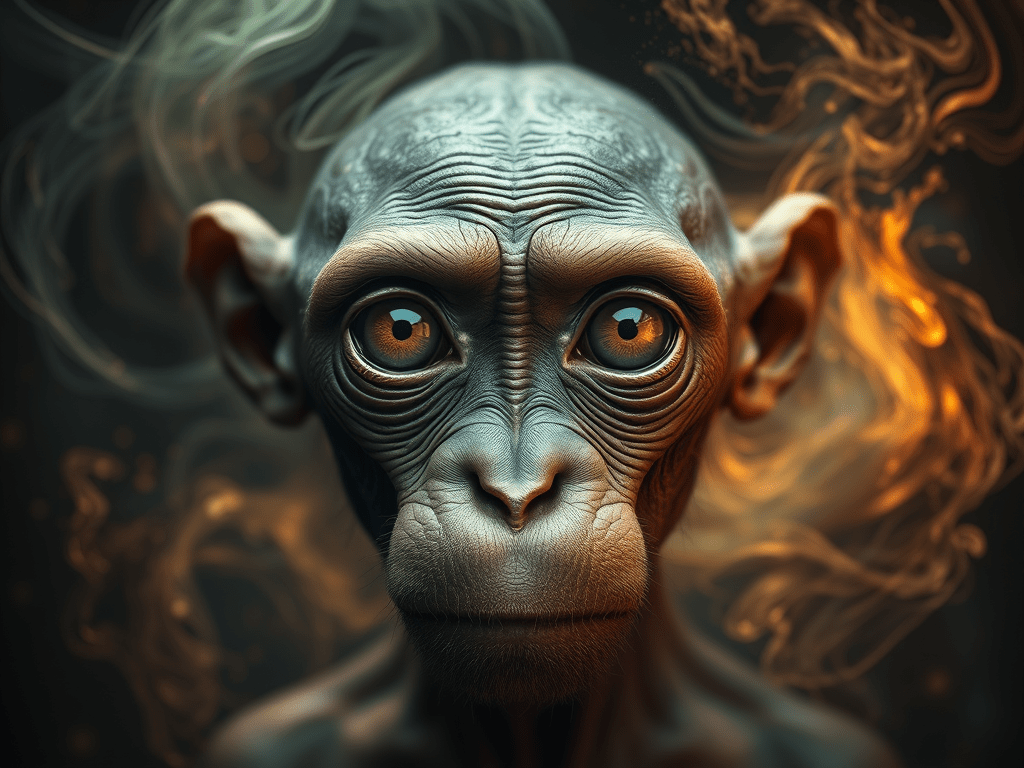
It’s truly a shame humanity is capable of such repugnance; that is the consequence of a mind that can conjure fiction, unfortunately. We Frankenstein our reality, shed the skin from our soul, and apply it to externalities like a blanket. Symbolic ideologies forged in our cerebral magnus opus known as fiction. Evil is the shadow of good. Good? We formed good from the constructive nature of our unique sentience. Our issue is that we often mistake this for the truth; our fiction is not absolutism. Our awareness of suffering allows us to both avoid it and create it; we forged the scalpel and the atom bomb. I often wonder if anything other than humanity is truly evil. Nature is wrathful, violent, and merciless, but it isn’t evil. When suns explode and engulf the life of planets around them, it isn’t out of evil, when the meteor hit the Earth and killed the dinosaurs, again, just a banality or byproduct of existing within infinite chaos and inverse entropy. Then we come along, this hairless ape that can do what seemingly nothing else can. I often imagine our big eyes and doughy faces, hairless and animated, how we ran the largest creatures to death through our endless drive. Faces full of alien expression to the rest of the animal kingdom, social signalling through a dance of fibres and muscles. To inhabit the fragility of a rodent and the idealistic drive to touch our gods. We are terrifying, even if we are minuscule to the rest of existence, we are a singularity that has convinced itself it’s multiples. Consciousness that has folded itself like origami, ontological denial, fiction, and cope, we are the hallucination in the reflection of an epistemological mirror. Emil Cioran referred to us as ‘The Maggot of Possibility’. Is our conscious mind an error, like the self-sabotage of cancer cells in the immune system? Peering in the dark with our oversized eyes, our minds of infinite outcomes, watching those who are minimalist cohabit nature, not deform it. We decay and we know it, we extrapolate joy despite knowing our very existence is entropic pain, trapped in linear time. We are nature’s Oedipus; the sphinx riddles us not with a question but with the notion that one can be asked. We resist the dynamic of the universe’s martyrdom, we refuse an end, Beckett’s denial of death, and our terror management. We fight against entropy like Jacob fought against God. Maybe it is just us fighting ourselves, wrestling with the shadows cast on the cave wall. Abomination or embodiment of anomalies within the infinite, we are human. Maybe if the sphinx could riddle us once more, it would ask, ‘What is the mind but the one that plays with the illusion of reality?
 AMKent books
Leave a comment